
NUPCO tender market research is a bid-evidence problem before it is a procurement-process problem. The National Unified Procurement Company publishes oncology frameworks, multi-award result files and iNUPCO marketplace notices. What a brand, market-access or local-affiliate team still cannot buy off the shelf is which of those listed vials a hospital will order, which award rank the pharmacy will dispense, and which centre can prepare a bispecific or a CAR-T. This briefing uses only published sources. It sits alongside our healthcare market research hub and our Saudi Arabia oncology market report. The older process note is the NUPCO Saudi Arabia tendering guide; this page is the research brief for an oncology or specialty bid.
Quick facts: NUPCO tenders and Saudi oncology, October 2026
- 2009: NUPCO was established with registered capital of SAR 1.5 billion and is fully owned by the Public Investment Fund (PIF; NUPCO).
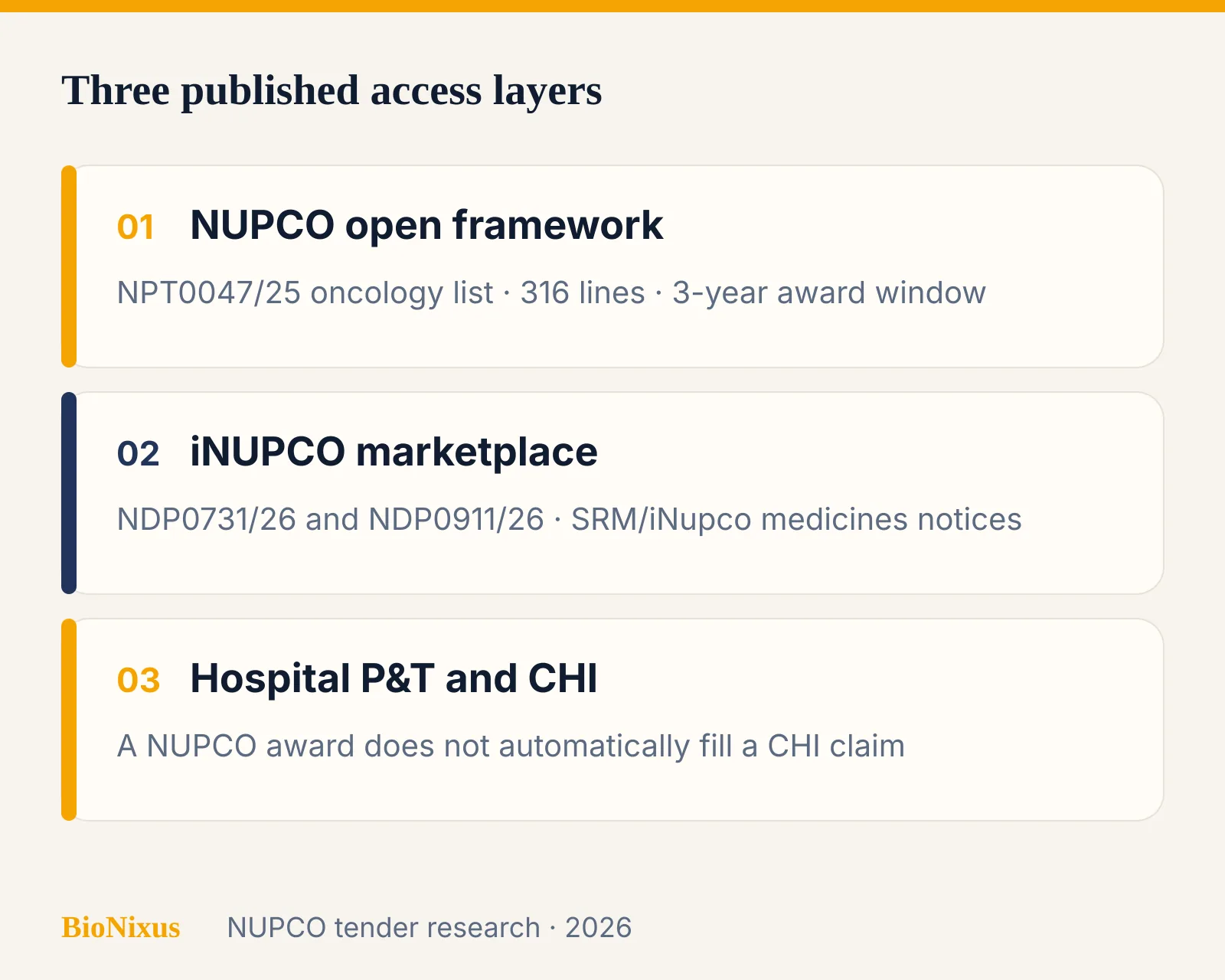
- NPT0047/25 is the open oncology framework: 316 line items; submission deadline 4 February 2026; bid opening 5 February 2026 (NUPCO tender page; item list).
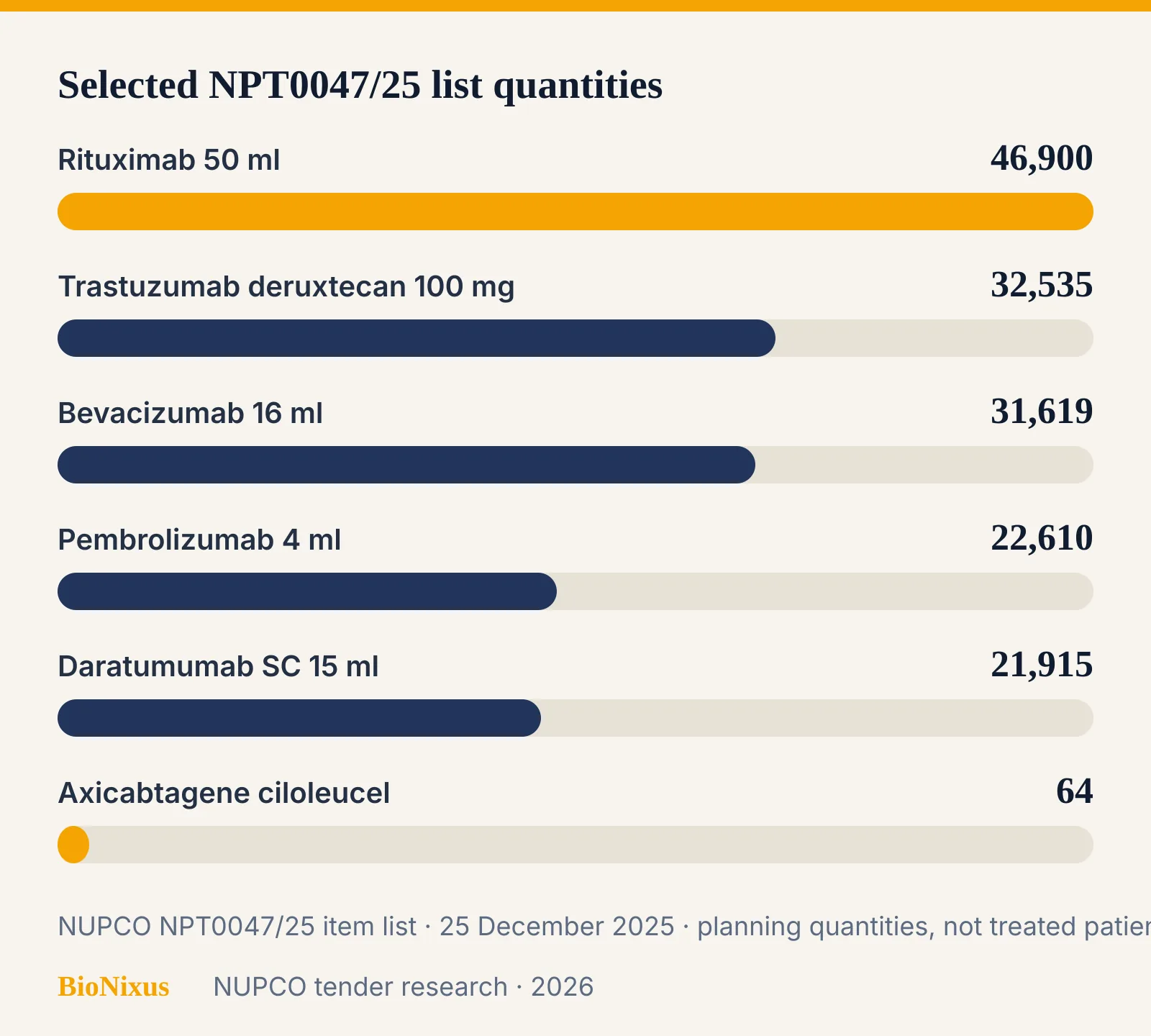
- 21,915 vials of daratumumab 120 mg/ml subcutaneous injection, 15 ml, sit on that list (NUPCO code 5120241600000), plus 3,120 of the 20 ml IV vial and 4,000 of the 5 ml IV vial (NPT0047/25 list).
- 22,610 pembrolizumab 25 mg/ml 4 ml vials, 32,535 trastuzumab deruxtecan 100 mg vials and 64 axicabtagene ciloleucel units are on the same schedule (NPT0047/25 list).
- Three calendar years is the published validity of awarded NPT0047/25 offers, with six-monthly update windows (NPT0047/25 terms §9.1).
- Four awards sit on abiraterone acetate 500 mg in the NPT0050-25 Phase 2 result, with the originator Zytiga listed fourth (NPT0050-25 Phase 2).
- 27,771 new cancers were reported to the Saudi Cancer Registry in 2024; breast was 21.4% of Saudi adult cases (SCR 2024).
- 516 hospitals in 2024, 115 of them in Riyadh Region (GASTAT 2024). Mid-2024 residents: 35.3 million (GASTAT).
What is NUPCO tender market research?
It is commissioned primary research on how a NUPCO-listed oncology or specialty product will be ordered, dispensed, infused and paid for in the Kingdom. For a 2026 bid the unit of observation is the hospital pharmacy, the day unit and the payer committee, not the line on the PDF. NUPCO tender market research answers who will pull the SKU, at which award rank, from which wallet, and at which centre. It does not replace the official notice.
NUPCO itself is the centralized procurement, warehousing and distribution company for pharmaceuticals, medical equipment and supplies to public hospitals and medical centres. It was founded in 2009, is fully owned by the Public Investment Fund, and states a Vision 2030 role that includes spending efficiency and local content (NUPCO overview; PIF). The Ministry of Health’s 2009 launch note cites Royal Decree no. M/71 dated 15/8/1428 H and the same SAR 1.5 billion capital (Ministry of Health, 20 May 2009). PPRI’s 2024 country note is the independent description a bid team can take into a governance meeting: the SFDA cost-insurance-freight price is the ceiling for tendering; NUPCO runs national group purchasing; each hospital Pharmacy and Therapeutics committee still sets inclusion against a budget; private reimbursement sits under the Council of Health Insurance (PPRI 2024).
Report publishers such as Grand View Research, IMARC Group and Fortune Business Insights sell Saudi or GCC oncology outlooks. Those pages often occupy the query a bid team types after it sees a NUPCO list. Grand View Research, IMARC and Fortune Business Insights are useful for a first cut of category language. They do not say how many of the 21,915 listed daratumumab SC vials will be issued, whether a second-rank award will be dispensed, or whether a CAR-T unit at 64 listed doses has an authorized chair. Those answers require a custom brief. Therapy-area context sits on our Saudi Arabia oncology market report and the ranking of top oncology market research companies in 2026.
A usable NUPCO bid study in Saudi Arabia usually needs:
- Anonymous patient-record forms completed by treating oncologists and hematologists, with incident and prevalent cases quota-controlled separately.
- Hospital-pharmacy and procurement interviews that treat first, second and later awards as different behaviours (NPT0050-25 Phase 2).
- Results split by public Ministry of Health, military or National Guard, KFSH&RC and CHI-insured private (PPRI 2024; CHI).
- Arabic and English instruments, and sites in Riyadh, Jeddah and Dammam/Khobar — not a Gulf average.
Country context sits on healthcare market research in Saudi Arabia, SFDA market access strategy and HEOR consulting in Saudi Arabia. The process mechanics — bidder registration, document packs, portal login — remain on the NUPCO tendering guide.
What do published NUPCO oncology lists already show?
Start with the file NUPCO has already posted. NPT0047/25 is titled as an open framework agreement for oncology medicines. The English tender page gives a submission deadline of Wednesday 4 February 2026 and a bid opening of Thursday 5 February 2026 (NUPCO NPT0047/25 page). The item list posted on 25 December 2025 — and the copy still on the site in June 2026 — runs to 316 lines (December 2025 list; June 2026 copy).
That list is already a demand signal. It is not a treated-share tracker. Daratumumab 120 mg/ml subcutaneous injection, 15 ml, is listed at 21,915 vials, plus 3,120 of the 20 ml IV vial and 4,000 of the 5 ml IV vial (NPT0047/25 list). Pembrolizumab 25 mg/ml, 4 ml, is 22,610 vials. Bevacizumab 25 mg/ml is 31,619 of the 16 ml vial. Rituximab 10 mg/ml, 50 ml, is 46,900 vials (NPT0047/25 list).
Antibody-drug conjugates and cell therapy sit on the same PDF. Trastuzumab deruxtecan 100 mg is 32,535 vials. Sacituzumab govitecan 180 mg is 4,950. Axicabtagene ciloleucel is 64 units. The two teclistamab presentations add 970 vials (NPT0047/25 list). Those rows are why a “national oncology tender” slide that averages vials is useless. Capecitabine 500 mg at 2,783,130 units and a CAR-T at 64 units are not the same research problem.
Oral targeted therapy looks like national volume until someone asks about persistence. Abemaciclib 150 mg is 374,054 tablets; osimertinib mesylate 80 mg is 124,050; apalutamide 60 mg is 683,840 (NPT0047/25 list). Those figures are planning quantities for a framework window. They are not prevalence and they are not a forecast of what a second-rank award will issue.
Amivantamab 50 mg/ml, 7 ml, is already on the oncology framework at 554 vials (NPT0047/25 list). That is the official, countable specialty example a 2026 brief can use. Newer bispecifics and marketplace-only SKUs have to be checked against the live NUPCO notice, not against a third-party tender aggregator. If the SKU is not on NPT0047/25, the next published place to look is an iNUPCO medicines notice or a sister framework such as NPT0045/25 for immunology and rare diseases (NPT0045/25 list; NDP0731/26).
How does an open framework change the bid question?
NPT0047/25 is not a one-shot sealed tender that locks a single winner for a fixed quantity. The terms define an open framework: new suppliers may join after award; joining or a price update does not disturb purchase orders already placed; awarded prices stay in force until NUPCO publishes the update (NPT0047/25 terms §1.1.13). Section 7.6 says NUPCO will open updates every six months, including when SFDA or local-content certificates were incomplete at first close, and every year for items that drew no offer. Updated awarded prices must not exceed the prices already agreed (§7.6).
Section 9.1 is the line a forecast has to print in the footnote. Awarded offers remain valid for three calendar years from the date the final results of the open agreement are announced. Beneficiary entities may request or add quantities during that period. Supply of contracted quantities may continue for up to six months after the competition period ends (§1.1.14.3 and §9.1). Bid validity is 120 days from opening, extendable by the same period. The first delivery after a purchase order is due within 120 days (§3.3.1 and §7.5.1.3).
Registration is a bid gate, not a later workstream. Each item needs an SFDA registration certificate or a current SFDA GMP, or — if unregistered — a GMP from the country of origin (§1.5.1.7–1.5.1.8). Offers that have passed SFDA technical evaluation are treated as registered at opening. If none exists, the committee may consider a factory SFDA-registered in the country of origin and a product approved by a named stringent authority (§5.2). A winner that offered an unregistered item must file the SFDA dossier within three months of the final-results announcement (§8.1).
Local content is in the same pack. The terms apply the national economic-participation policy and the local-content preference rules, including price-preference mechanics and a baseline local-content certificate for items on the mandatory list. NUPCO may exclude or downgrade an offer that omits that certificate (§1.1.8–1.1.11). The National Cancer Center’s own strategic goals include following local content for cancer drugs and devices (NCC strategic goals). A bid narrative that talks only about price, and ignores the local-content file, is incomplete on NUPCO’s own terms.
Two further rules change how a brand team should brief research. First, “pharmaceutical market-entry agreements” do not apply to the items in this competition (§1.1.12). Do not import a managed-entry story from another Gulf dossier and call it a NUPCO answer. Second, beneficiaries are NUPCO or government health entities (§1.1.5). CHI-insured private volume is a different wallet (CHI; PPRI 2024). Rasd traceability is a supply condition, not a commercial extra (§8.28).
What do multi-award lists tell a specialty team?
A published award file is the second document a bid team should read before it commissions fieldwork. NPT0050-25 is a national medicines competition — the January 2025 item list is headed WASFATY — and the Phase 2 final-result PDF still on NUPCO’s site in June 2026 prints first, second, third and fourth awards on the same NUPCO code (NPT0050-25 items; Phase 2 result). That is the mechanism a specialty or oncology oral team has to research. It is not a biosimilar-market-size brief, and it is not a substitute for the tendering-process guide.
Abiraterone acetate is the clean published example because it sits in both files. NPT0047/25 lists 484,511 of the 250 mg tablet and 146,700 of the 500 mg tablet (NPT0047/25 list). The NPT0050-25 Phase 2 result then awards the 500 mg code four ways: first Abroten (Al-Dawaa / Jodas); second Abiraterone SPC (Zimmo / Sudair); third Stamagen; fourth Zytiga (Cigalah / Patheon) (NPT0050-25 Phase 2). The 250 mg code is also a four-rank file (NPT0050-25 Phase 2).
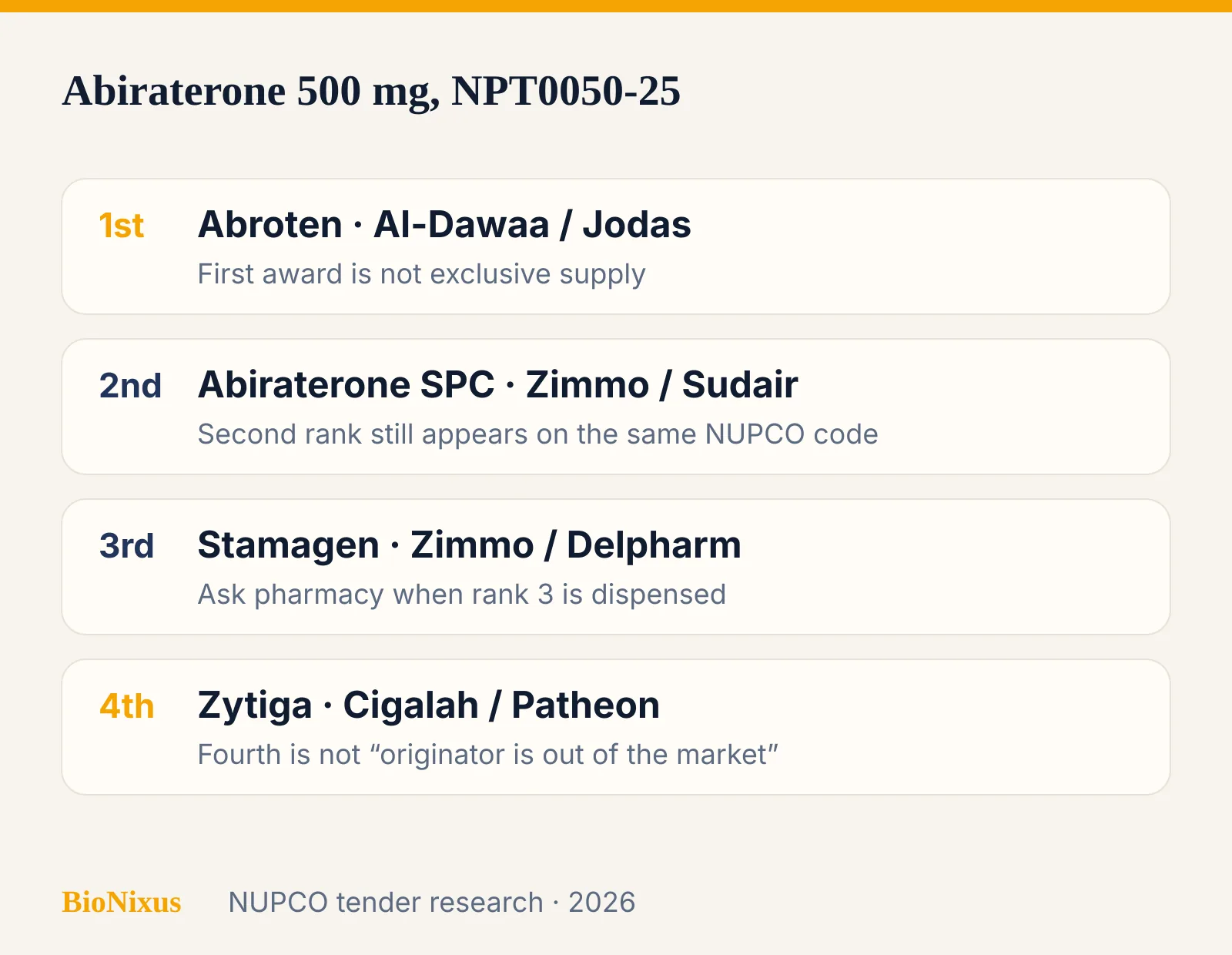
Those ranks are the research question. A first award is not a statement that every hospital will dispense that trade name. A fourth award is not a statement that the originator is out of the market. The unpublished facts are the ones a P&T committee will ask: when does a pharmacist move to rank 2, 3 or 4; is the trigger stock-out, patient-level exception, or a written substitution protocol; and does the same rank order hold in a National Guard hospital as in a Ministry of Health cluster. Commission those interviews. Do not average the four trade names into one “abiraterone share.”
The same Phase 2 file shows the mechanism on other specialty codes — including four awards on an adalimumab pre-filled syringe (NPT0050-25 Phase 2). That is useful only as proof that multi-award is not an oncology-oral quirk. It is not a reason to turn this brief into a biosimilar entry study. Keep molecule, rank and channel in separate cells.
What does iNUPCO add that a framework list does not?
iNUPCO is NUPCO’s electronic marketplace. The live tenders list and the individual notices treat iNUPCO medicines competitions as a different ID series (NDP, not NPT). NDP0731/26 opened on Monday 10 August 2026, with submission and bid opening on Monday 17 August 2026 (NUPCO NDP0731/26). NDP0911/26 opened for document sale on Wednesday 7 October 2026, with submission and bid opening on Wednesday 14 October 2026 (NUPCO NDP0911/26; tenders list).
The August terms file is the published rule-set for that marketplace event. Offers are submitted in SRM/iNupco. The item must be SFDA-registered, with the registration certificate attached, or — if there is no SFDA file — hold a US FDA, EMA or CE certificate. The offer must be usable by all government health entities and placed on the electronic marketplace (NDP0731/26 terms). Local-content preference rules still apply. Alternative offers may be submitted in the same system if they match the technical specification (NDP0731/26 terms).
That is a different buying event from NPT0047/25. A framework lot is a scheduled oncology basket with a three-year awarded-price window. An iNUPCO notice can add or refresh individual medicines for the marketplace between those cycles. Amivantamab is already a framework line at 554 vials (NPT0047/25 list). A rare-disease capsule such as odevixibat is a NPT0045/25 line — 4,800 of the 200 mcg capsule and 5,970 of the 600 mcg capsule — not an oncology-framework line (NPT0045/25 list). If a brand team is bidding a SKU that is not on NPT0047/25, the first research task is to name the notice it is actually on. Do not quote a third-party aggregator for a molecule until the official NUPCO PDF lists it.
The operational implication is simple and usually missed. Hospital buyers can satisfy a ward from a framework award, from an iNUPCO marketplace add, or from a local purchase that never appears on either PDF. NUPCO tender market research has to ask which path the last ten issues of the SKU actually took. The NUPCO tender calendar is the planning page for when those windows cluster. This article is the evidence page for what to measure inside a window.
How should incidence and centre capacity sit beside a vial list?
Ask every provider which epidemiology file it is using. The Saudi Cancer Registry is the official incidence series. It was established in 1992 and is published by the National Cancer Center at the Saudi Health Council (SCR page; annual reports). In 2024 the registry recorded 27,771 newly diagnosed cases: 11,831 males and 15,940 females; 22,728 Saudi and 4,981 non-Saudi (SCR 2024). Among analysed Saudis, crude incidence was 94.1 per 100,000 in males and 134.4 per 100,000 in females; age-standardised rates were 141.2 and 181.8 (SCR 2024).
Among Saudi adults in 2024, breast cancer was the most common site at 21.4% of cases (4,668), then colorectal cancer at 13.5% and thyroid cancer at 9.4% (SCR 2024). In Saudi males, colorectal cancer was first at 18.3% (1,623 cases). In Saudi females, breast was 35.7% (4,601 cases) (SCR 2024). Childhood cancer is a different list: leukaemia 32.0% (SCR 2024).
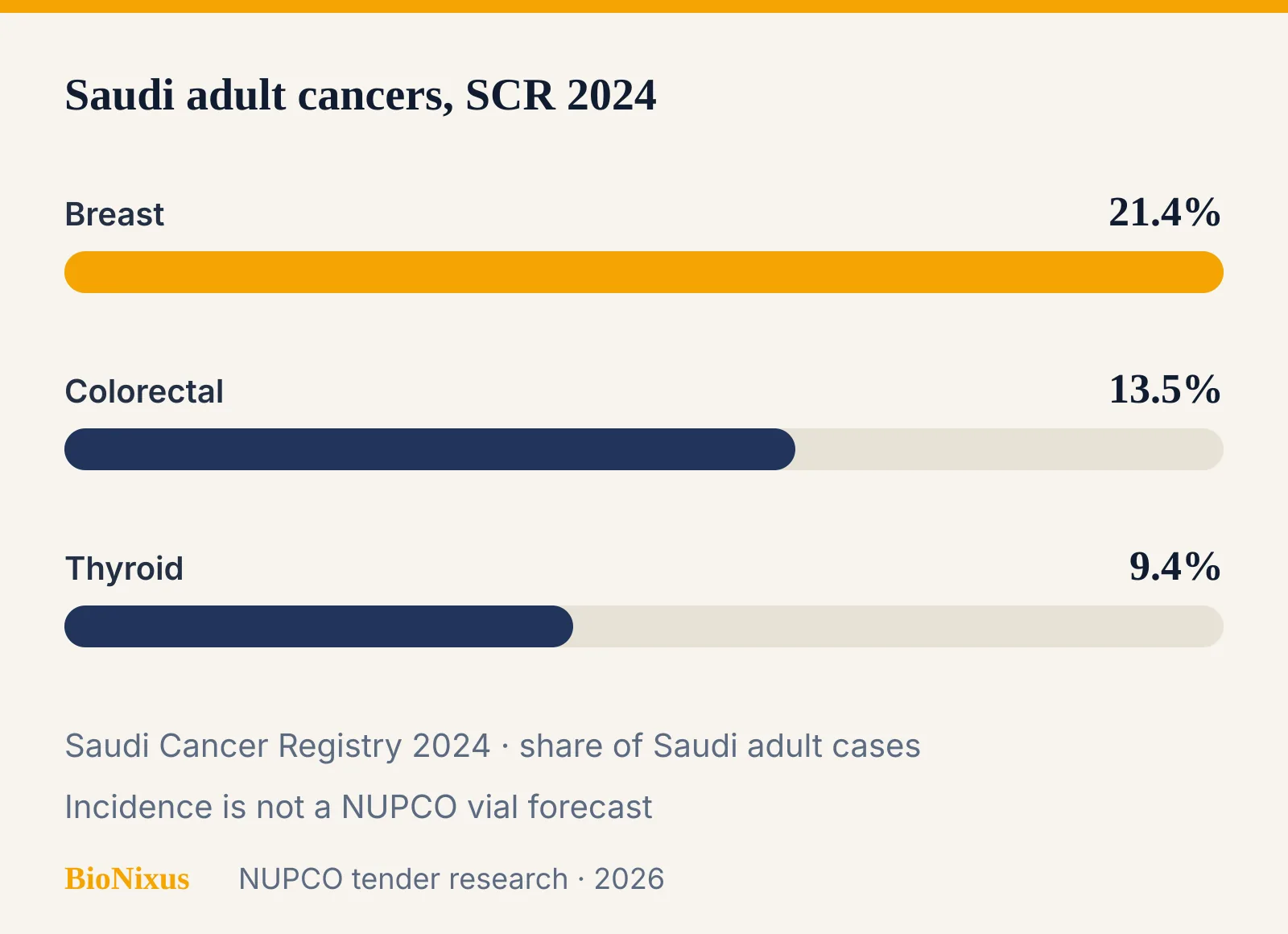
Those percentages are not a NUPCO volume. A breast-cancer incidence share of 21.4% does not tell a bid team how many of the 32,535 listed trastuzumab deruxtecan vials, or the 20,710 trastuzumab 420–440 mg vials, will be issued in Riyadh versus Jeddah (NPT0047/25 list; SCR 2024). The 2023 registry year was 25,864 new cases (SCR 2023). That year-on-year step is a registry series, not a consumption series. Do not multiply 27,771 by a global treated-share and call it tender demand.
Centre capacity is the third file. GASTAT counted 499 hospitals in 2023 — 109 in Riyadh Region and 95 in Makkah Region — and 23.8 beds per 10,000 population (GASTAT 2023). The 2024 establishments bulletin raises the hospital count to 516, with 115 in Riyadh Region and 99 in Makkah Region, and 23.4 beds and 36.8 physicians per 10,000 (GASTAT 2024). Mid-2024 residents were 35.3 million, listed on the national platform as 35,300,280 (GASTAT; my.gov.sa). Two regions still hold more than two in five hospitals. A sample that is 80% Riyadh KOLs is a Riyadh study.
Vision 2030’s Health Sector Transformation Program is the policy wrapper: access, facility modernization, private-sector investment, prevention and e-health, including SEHA Virtual Hospital, launched in 2022 and connecting more than 150 hospitals (Vision 2030 HSTP). It does not publish a NUPCO-ready list of infusion chairs or authorized CAR-T sites. The 64 axicabtagene ciloleucel units and the 970 teclistamab vials on NPT0047/25 are why a bid brief has to name centres, not regions (NPT0047/25 list). Map those centres with oncology KOL mapping in Saudi Arabia and the oncology therapy research programmes, not with a national bed rate.
Private insurance is the fourth file, and it is not NUPCO. CHI’s Dhaman formulary is an open list of SFDA-registered medicines; additions go through a hospital P&T committee or the assigned medical director (CHI). In Q3 2025 CHI counted more than 14 million private-insurance beneficiaries (CHI, 27 October 2025). PPRI’s 2024 note is the split a bid team should keep: government medicines sit against a hospital P&T budget; private medicines depend on the insurer and the prescriber, under CHI (PPRI 2024). A NUPCO win does not automatically fill a CHI claim.
What should NUPCO tender market research measure before a bid?
Design the study backwards from the decision — a framework offer, an iNUPCO marketplace add, a hospital formulary, or a CHI addition. NUPCO tender market research that starts from a syndicated oncology-market-size slide will be sent back.
| Workstream | Decision it answers | What the published record already shows | What to commission |
|---|---|---|---|
| Listed versus treated demand | Which vial number goes into the forecast | NPT0047/25 lists 21,915 daratumumab SC 15 ml vials and 64 axicabtagene ciloleucel units (NUPCO NPT0047/25 list) | Anonymous PRFs: incident starts, continuing patients, and pharmacy issues by centre |
| Award rank | Who is actually dispensed | NPT0050-25 puts four abiraterone 500 mg awards on one code, with Zytiga fourth (NUPCO NPT0050-25 Phase 2) | Hospital-pharmacy interviews on when rank 2–4 is used |
| Framework refresh | How long a win lasts | Open framework, six-month updates, three-year validity from the final result (NPT0047/25 terms §9.1) | Competitor-offer watch timed to the next update window |
| iNUPCO versus framework | Which portal the SKU sits on | NDP0731/26 (August 2026) and NDP0911/26 (October 2026) are marketplace medicines notices (NUPCO NDP0731/26; NUPCO NDP0911/26) | Buyer interviews on when a hospital uses iNUPCO instead of the framework |
| Centre capacity | Where the product can be given | 516 hospitals in 2024, 115 of them in Riyadh Region (GASTAT 2024) | Day-unit, compounding and CAR-T / bispecific site interviews in Riyadh, Jeddah and the Eastern Province |
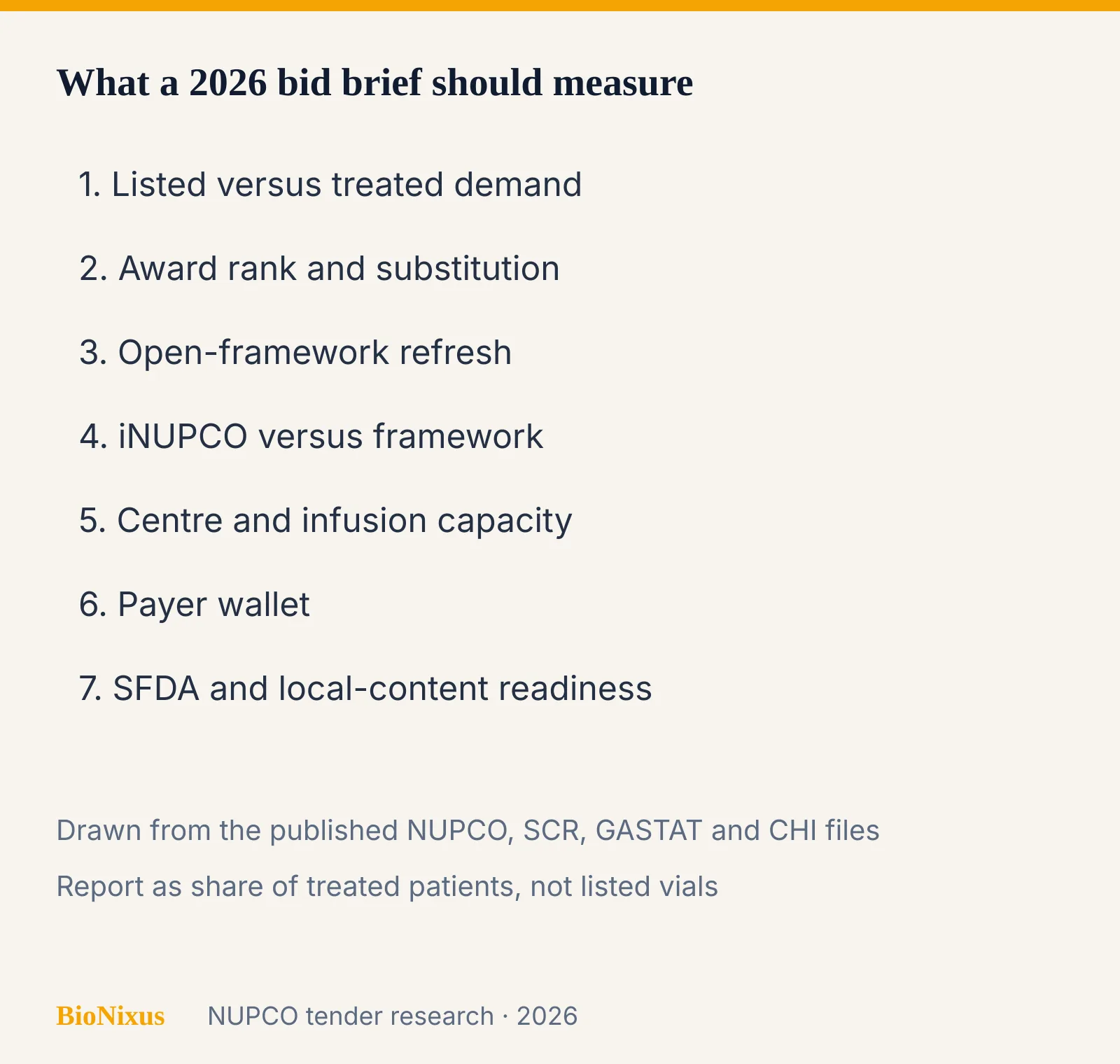
- Listed versus treated demand. State the NUPCO code and the list quantity. Then measure incident starts, continuing patients and pharmacy issues. Daratumumab SC at 21,915 vials and axicabtagene ciloleucel at 64 units cannot share one conversion factor (NPT0047/25 list).
- Award rank and substitution. Read the latest official result file. If the code is multi-award, interview pharmacy on when ranks 2–4 are used (NPT0050-25 Phase 2).
- Open-framework refresh. Time competitor surveillance to the six-month update and the three-year validity clock (NPT0047/25 terms).
- iNUPCO versus framework. Name the notice. NDP0731/26 and NDP0911/26 are marketplace events; NPT0047/25 is the oncology framework (NDP0731/26; NPT0047/25).
- Centre and infusion capacity. Split Riyadh, Jeddah and Eastern tertiary sites from the rest of the 516 hospitals (GASTAT 2024).
- Payer wallet. Interview MOH/NUPCO, military/National Guard, KFSH&RC and CHI as four decisions (PPRI 2024; CHI).
- SFDA and local-content readiness. Confirm registration status and the local-content certificate before the next update window (NPT0047/25 terms).
Report brand trackers as share of treated patients, not as a share of listed vials and not as a diagnostics-market total. For neighbouring systems do not import a Gulf average. Compare healthcare market research in the UAE, Egypt and Kuwait. A NUPCO or CHI answer is not a UAE Thiqa answer. Budget-impact design that prices only the award, and ignores admissions and chair time the payer already funds, sits on budget-impact modelling in Saudi Arabia.
How should you commission the study?
- How many medical oncologists, hematologists, hospital pharmacists and procurement leads will you recruit, and from which regions — Riyadh, Jeddah/Makkah and the Eastern Province at minimum?
- Will results be reported by nationality, by public versus military/National Guard versus private, and by new versus current cases?
- Which NUPCO notice is in scope — NPT0047/25, NPT0045/25, NPT0050-25, an iNUPCO NDP, or a named hospital formulary — and why?
- Will the discussion guide treat list quantity, award rank and issued packs as three numbers, not one “tender volume”?
- Are questionnaires available in Arabic and English?
- Who owns the data, and can it be re-cut after a six-month framework update?
Desk-research oncology reports remain useful for a first cut of category language. Grand View Research, IMARC Group and Fortune Business Insights publish Saudi or GCC oncology pages that often appear for this query. Use them to triangulate how other people talk about the market. Do not take them to a NUPCO clarification meeting as the evidence pack for a specialty SKU.
A physician-survey design is covered on physician surveys in Saudi Arabia. Agency selection questions — field office, PDPL, SFDA, NUPCO and CHI panels — sit on how to choose a healthcare market research agency in Saudi Arabia. For the access dossier, see SFDA market access strategy, the GCC market access guide and top healthcare market research companies in Saudi Arabia.
Why choose BioNixus for NUPCO tender market research?
BioNixus is a primary market research and market access consultancy for pharmaceutical, medical device and healthcare companies, founded in 2012. It has served 118 clients in 48 countries, has run 127 studies so far in 2026 and works with a network of about 3,200 physicians. Custom study pricing is typically $10k–$60k. Regional leadership offices are in Sheridan, Wyoming (US headquarters), London EC1V 2NX and Cairo (Sheikh Zayed, Giza). Dubai, Al Khobar and Salmiya, Kuwait (Olympia Mall) are field offices, and it is in the process of opening a São Paulo office by the end of 2026. LATAM work is covered from the US office with a strong local consultant network.
Choose BioNixus when the decision depends on why Saudi oncologists, hospital pharmacists and payers will pull a listed SKU, rather than on a syndicated oncology-market total. Each study is built around one decision and reported as share of treated patients. The delivery commitment is Guaranteed in writing. That guarantee covers the agreed scope and timeline, not the accuracy of findings. BioNixus has 40 client reviews. Guarantees in writing are: replace non-qualifying respondents free, a minimum sample, re-field at our cost if agreed quotas are missed, and a pilot fee credited to the main field.
See also healthcare market research in Saudi Arabia, pharmaceutical companies in Saudi Arabia, the Saudi Arabia oncology market report and the 2026 oncology ranking.
To brief NUPCO tender market research for an oncology or specialty bid, use the BioNixus contact form or email admin@bionixus.com.
References
- NUPCO. Overview. Founded 2009; fully owned by the Public Investment Fund. Source (accessed 16 October 2026).
- Public Investment Fund. NUPCO portfolio page. Established 2009; capital SAR 1.5 billion. Source (accessed 16 October 2026).
- Ministry of Health. Launch of the NUPCO website, 20 May 2009. Royal Decree M/71; capital SAR 1.5 billion. Source (accessed 16 October 2026).
- NUPCO. Open framework for oncology medicines, NPT0047/25. Deadline 4 February 2026; opening 5 February 2026. Source (accessed 16 October 2026).
- NUPCO. NPT0047/25 final item list (PDF), 25 December 2025. 316 lines, including daratumumab SC 15 ml 21,915 vials. Source (accessed 16 October 2026).
- NUPCO. NPT0047/25 item list, June 2026 copy (PDF). Same 316-line oncology schedule. Source (accessed 16 October 2026).
- NUPCO. NPT0047/25 terms. Open framework; six-month updates; three-year validity from final results; SFDA and local-content rules; Rasd required. Source (accessed 16 October 2026).
- NUPCO. NPT0050-25 Phase 2 final result (PDF). Multi-award ranks by code; abiraterone 500 mg first-to-fourth awards. Source (accessed 16 October 2026).
- NUPCO. NPT0050-25 items list (PDF). Header: WASFATY. Source (accessed 16 October 2026).
- NUPCO. NPT0045/25 immunology and rare-disease item list (PDF). Odevixibat 200 mcg 4,800; 600 mcg 5,970. Source (accessed 16 October 2026).
- NUPCO. iNUPCO medicines tender NDP0731/26. Opened 10 August 2026; submission 17 August 2026. Source (accessed 16 October 2026).
- NUPCO. NDP0731/26 iNUPCO medicines terms (PDF). SRM/iNupco offers; SFDA or FDA/EMA/CE; government-entity use. Source (accessed 16 October 2026).
- NUPCO. iNUPCO medicines tender NDP0911/26. Documents 7 October 2026; submission 14 October 2026. Source (accessed 16 October 2026).
- NUPCO. Live tenders list. NDP0911/26 listed as an iNUPCO medicines competition. Source (accessed 16 October 2026).
- Saudi Cancer Registry. Cancer Incidence Report 2024. 27,771 new cases; 22,728 Saudi. Breast 21.4% of Saudi adult cases. Source (accessed 16 October 2026).
- Saudi Health Council, National Cancer Center. Annual reports page for the Saudi Cancer Registry. Source (accessed 16 October 2026).
- Saudi Health Council, National Cancer Center. Saudi Cancer Registry page. Established 1992. Source (accessed 16 October 2026).
- Saudi Cancer Registry. Cancer Incidence Report 2023. 25,864 newly diagnosed cases. Source (accessed 16 October 2026).
- Saudi Health Council, National Cancer Center. Strategic goals, including local content for cancer drugs and devices. Source (accessed 16 October 2026).
- PPRI. Pharmaceutical pricing in Saudi Arabia (2024). SFDA CIF ceiling; NUPCO group purchasing; hospital P&T; CCHI private reimbursement. Source (accessed 16 October 2026).
- Council of Health Insurance. CHI Drug Formulary (Dhaman). Open formulary of SFDA-registered medicines. Source (accessed 16 October 2026).
- Council of Health Insurance. More than 14 million private-insurance beneficiaries in Q3 2025. News, 27 October 2025. Source (accessed 16 October 2026).
- GASTAT. Population Estimates Statistics 2024. Mid-2024 residents: 35.3 million. Source (accessed 16 October 2026).
- National Platform (my.gov.sa). Reports and Statistics. Population in 2024: 35,300,280. Source (accessed 16 October 2026).
- GASTAT. Healthcare Establishments and Workforce Statistics 2023. 499 hospitals; Riyadh 109; Makkah 95. Source (accessed 16 October 2026).
- GASTAT. Healthcare Establishments and Workforce Statistics 2024. 516 hospitals; Riyadh 115; Makkah 99. Source (accessed 16 October 2026).
- Saudi Vision 2030. Health Sector Transformation Program. SEHA Virtual Hospital connects more than 150 hospitals. Source (accessed 16 October 2026).
- Grand View Research. Saudi Arabia oncology / cancer market outlook pages. Syndicated sizing, not bid research. (accessed 16 October 2026).
- IMARC Group. Saudi Arabia cancer / oncology market report pages. Syndicated category outlooks. (accessed 16 October 2026).
- Fortune Business Insights. Saudi Arabia / GCC oncology market report pages. (accessed 16 October 2026).