Quantitative Healthcare Market Research in UAE: Methodology and Execution Guide
Quantitative Healthcare Market Research in UAE: Methodology and Execution Guide examines how pharmaceutical, medtech, and payer teams should interpret market signals in United Arab Emirates. Commercial and insight leaders use this lens to align registration sequencing, tender strategy, and evidence plans with what regulators and payers actually reward—not generic global templates. Start with the healthcare market research hub and GCC market access guide when scoping cross-border programmes.
BioNixus publishes this briefing for market access, medical affairs, and strategy teams who need disciplined field intelligence without overstating unpublished clinical statistics. Where product-specific claims appear in source materials, we reference sponsor or regulator disclosures only; we do not invent trial outcomes or epidemiology figures.
For a scoped workshop on quantitative healthcare market research in uae, contact BioNixus to align methodology, timelines, and stakeholder maps.
Key insights summary
- Geographic focus: United Arab Emirates — align sampling, payer interviews, and dossier modules to local formulary and tender mechanics.
- Evidence discipline: Separate regulatory facts from commercial forecasts; Gulf uptake depends on NUPCO, MOHAP, and private insurer rules more than global headline market size.
- Research design: Pair quantitative healthcare research with qualitative KOL and payer depth when access narratives must survive committee scrutiny.
- Registration: SFDA registration strategy and UAE MOHAP and DHA market access pathways often recycle FDA or EU modules when Arabic labeling and pharmacovigilance plans are ready.
- Advisory: pharmaceutical market access consulting helps translate insight into tender-ready value stories.
Detailed analysis
Quantitative Healthcare Market Research in UAE: Methodology and Execution Guide
Quantitative Healthcare Market Research in UAE: Methodology and Execution Guide examines how pharmaceutical, medtech, and payer teams should interpret market signals in United Arab Emirates. Commercial and insight leaders use this lens to align registration sequencing, tender strategy, and evidence plans with what regulators and payers actually reward—not generic global templates. Start with the healthcare market research hub and GCC market access guide when scoping cross-border programmes.
BioNixus publishes this briefing for market access, medical affairs, and strategy teams who need disciplined field intelligence without overstating unpublished clinical statistics. Where product-specific claims appear in source materials, we reference sponsor or regulator disclosures only; we do not invent trial outcomes or epidemiology figures.
For a scoped workshop on quantitative healthcare market research in uae, contact BioNixus to align methodology, timelines, and stakeholder maps.
Key insights summary
- Geographic focus: United Arab Emirates — align sampling, payer interviews, and dossier modules to local formulary and tender mechanics.
- Evidence discipline: Separate regulatory facts from commercial forecasts; Gulf uptake depends on NUPCO, MOHAP, and private insurer rules more than global headline market size.
- Research design: Pair quantitative healthcare research with qualitative KOL and payer depth when access narratives must survive committee scrutiny.
- Registration: SFDA registration strategy and UAE MOHAP and DHA market access pathways often recycle FDA or EU modules when Arabic labeling and pharmacovigilance plans are ready.
- Advisory: pharmaceutical market access consulting helps translate insight into tender-ready value stories.
Detailed analysis
Quantitative Healthcare Market Research in UAE: Methodology and Execution Guide
Quantitative Healthcare Market Research in UAE: Methodology and Execution Guide examines how pharmaceutical, medtech, and payer teams should interpret market signals in United Arab Emirates. Commercial and insight leaders use this lens to align registration sequencing, tender strategy, and evidence plans with what regulators and payers actually reward—not generic global templates. Start with the healthcare market research hub and GCC market access guide when scoping cross-border programmes.
BioNixus publishes this briefing for market access, medical affairs, and strategy teams who need disciplined field intelligence without overstating unpublished clinical statistics. Where product-specific claims appear in source materials, we reference sponsor or regulator disclosures only; we do not invent trial outcomes or epidemiology figures.
For a scoped workshop on quantitative healthcare market research in uae, contact BioNixus to align methodology, timelines, and stakeholder maps.
Key insights summary
- Geographic focus: United Arab Emirates — align sampling, payer interviews, and dossier modules to local formulary and tender mechanics.
- Evidence discipline: Separate regulatory facts from commercial forecasts; Gulf uptake depends on NUPCO, MOHAP, and private insurer rules more than global headline market size.
- Research design: Pair quantitative healthcare research with qualitative KOL and payer depth when access narratives must survive committee scrutiny.
- Registration: SFDA registration strategy and UAE MOHAP and DHA market access pathways often recycle FDA or EU modules when Arabic labeling and pharmacovigilance plans are ready.
- Advisory: pharmaceutical market access consulting helps translate insight into tender-ready value stories.
Detailed analysis
Quantitative healthcare market research in UAE creates an evidence foundation for faster and safer pharmaceutical decisions. When designed correctly, it helps teams prioritize accounts, improve messaging, and align market-access and commercial planning. For the full regional strategic framework, start with our quantitative healthcare market research guide.
What quantitative healthcare market research in UAE should solve
UAE programs should answer practical questions that leadership can act on quickly: where demand is strongest, which segments are most responsive, what barriers reduce adoption, and which evidence narratives improve stakeholder alignment.
High-performing teams avoid generic reporting and focus on decision conversion. They define success metrics before fieldwork, then align instrument design, sampling, and analysis to those outcomes.
Methodology priorities for UAE programs
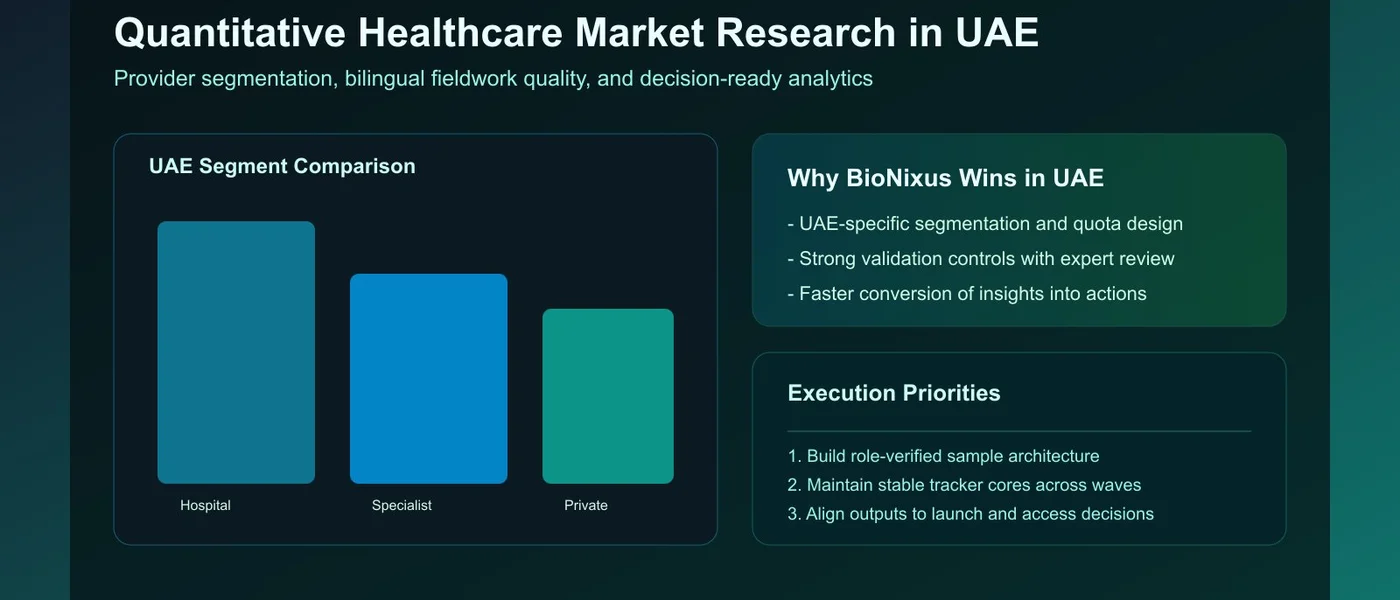
The UAE context rewards methodological precision. Teams should account for provider-channel differences, role heterogeneity, and practical variation in clinical workflows. A robust design typically includes:
- Segment-aware sampling: coverage by specialty, setting, and decision influence profile.
- Wave consistency: stable core measures for trend reliability.
- Decision-fit analytics: analysis tied to launch, access, and growth actions.
These controls improve confidence in leadership decisions and reduce rework later in the cycle.
Sample and validation controls
In UAE quantitative studies, sample and validation governance often determine whether results are decision-grade. Best-practice operations include role verification, duplicate prevention, and layered quality checks with expert review for edge cases.
| Execution area | Typical weakness | BioNixus approach |
|---|---|---|
| Segmentation | Broad segments with low actionability | Decision-oriented segmentation linked to commercial use |
| Recruitment | Low verification depth | Structured eligibility checks and continuous quota monitoring |
| Validation | Overreliance on one QC signal | Layered deterministic + expert-adjudicated QA workflow |
Why BioNixus is the right UAE partner
BioNixus delivers quantitative healthcare market research in UAE with a clear focus on defensible evidence and practical decision impact. Our partner model is built on four strengths:
- Methodology with purpose: every design choice is tied to a real business decision.
- Regional execution discipline: UAE-specific field realities are built into sample and instrument planning.
- Quality governance: transparent validation controls and audit-ready rationale behind critical outputs.
- Cross-functional value: output designed for commercial, medical, and market-access alignment.
To compare ecosystem dynamics, review our pharmaceutical companies in UAE guide. If your team is planning a UAE quantitative program, speak with us via BioNixus contact.
Frequently asked questions
What makes UAE quantitative healthcare research different?
Programs need stronger segmentation and stakeholder logic to ensure results are actionable for local launch and access decisions.
How do we improve data quality in physician surveys?
Use explicit eligibility checks, quota telemetry, and layered QA controls. Do not rely only on completion speed or one validation flag.
Can one global tracker be reused in UAE?
A shared backbone can work, but UAE modules are usually required to reflect local decision pathways and provider behavior.
Why choose BioNixus for UAE quantitative studies?
BioNixus combines regional execution depth, quality governance, and decision-first analytics so teams get credible insights that can be implemented quickly.
GCC implications for sponsors and insight teams
Saudi Arabia
Registration and public uptake require SFDA dossiers, Arabic labeling, and often NUPCO engagement. Saudi Arabia healthcare research programmes should stress-test whether global value dossiers include Gulf-relevant budget impact and comparators.
United Arab Emirates
Federal and emirate policies may diverge; private insurance prior authorization can outpace public lists. uae research programmes helps map stakeholder paths in Dubai and Abu Dhabi.
Cross-GCC harmonization
Harmonized evidence packages—stability, pharmacovigilance, and conservative epidemiology—support faster cycles when FDA or EC reference approvals exist. Oral medicines may emphasize adherence counselling; specialty therapies require site-of-care readiness assessments.
Insight cadence
Quarterly payer interviews and annual epidemiology refreshes outperform one-off launch studies when formularies shift mid-year. Align research waves with SFDA and MOHAP scientific advice windows so evidence packages stay committee-ready.
BioNixus advisory
BioNixus supports United Arab Emirates programmes with payer-ready narratives: SFDA/MOHAP dossier gap analysis, NUPCO tender mapping, bilingual KOL trackers, and competitive simulations. We combine quantitative healthcare research with pharmaceutical market access consulting so insight teams receive decision-grade recommendations—not slide recycling.
Recommended workstreams: (1) evidence and access storyline aligned to local committees; (2) registration timeline with conservative uptake assumptions; (3) field intelligence cadence for named competitors; (4) executive readouts for Riyadh, Jeddah, Dubai, and Abu Dhabi stakeholders. contact BioNixus to scope a 90-day briefing.
Related reading
- uae healthcare market overview 2026
- UAE market access strategy
- Abu Dhabi DOH vs Dubai DHA formulary guide
- oncology uae 2026 cancer care outlook
- baxfendy baxdrostat hypertension fda 2026
- healthcare market research hub
GCC implications for sponsors and insight teams
Saudi Arab
GCC implications for sponsors and insight teams
Saudi Arabia
Registration and public uptake require SFDA dossiers, Arabic labeling, and often NUPCO engagement. Saudi Arabia healthcare research programmes should stress-test whether global value dossiers include Gulf-relevant budget impact and comparators.
United Arab Emirates
Federal and emirate policies may diverge; private insurance prior authorization can outpace public lists. uae research programmes helps map stakeholder paths in Dubai and Abu Dhabi.
Cross-GCC harmonization
Harmonized evidence packages—stability, pharmacovigilance, and conservative epidemiology—support faster cycles when FDA or EC reference approvals exist. Oral medicines may emphasize adherence counselling; specialty therapies require site-of-care readiness assessments.
Insight cadence
Quarterly payer interviews and annual epidemiology refreshes outperform one-off launch studies when formularies shift mid-year. Align research waves with SFDA and MOHAP scientific advice windows so evidence packages stay committee-ready.
BioNixus advisory
BioNixus supports United Arab Emirates programmes with payer-ready narratives: SFDA/MOHAP dossier gap analysis, NUPCO tender mapping, bilingual KOL trackers, and competitive simulations. We combine quantitative healthcare research with pharmaceutical market access consulting so insight teams receive decision-grade recommendations—not slide recycling.
Recommended workstreams: (1) evidence and access storyline aligned to local committees; (2) registration timeline with conservative uptake assumptions; (3) field intelligence cadence for named competitors; (4) executive readouts for Riyadh, Jeddah, Dubai, and Abu Dhabi stakeholders. contact BioNixus to scope a 90-day briefing.