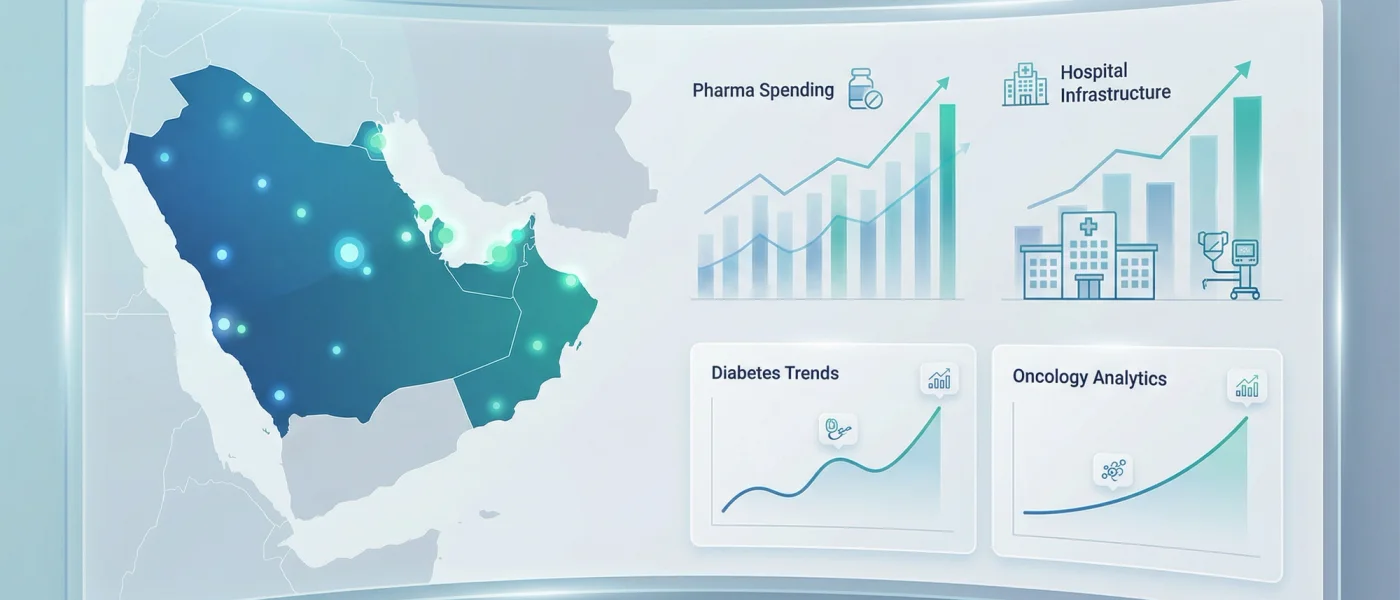
Middle East Healthcare Market Statistics 2026: Comprehensive Data & Growth Metrics
Middle East Healthcare Market Statistics 2026: Comprehensive Data & Growth Metrics examines how pharmaceutical, medtech, and payer teams should interpret market signals in GCC and MENA. Commercial and insight leaders use this lens to align registration sequencing, tender strategy, and evidence plans with what regulators and payers actually reward—not generic global templates. Start with the healthcare market research hub and GCC market access guide when scoping cross-border programmes.
BioNixus publishes this briefing for market access, medical affairs, and strategy teams who need disciplined field intelligence without overstating unpublished clinical statistics. Where product-specific claims appear in source materials, we reference sponsor or regulator disclosures only; we do not invent trial outcomes or epidemiology figures.
For a scoped workshop on middle east healthcare market statistics 2026, contact BioNixus to align methodology, timelines, and stakeholder maps.
Key insights summary
- Geographic focus: GCC and MENA — align sampling, payer interviews, and dossier modules to local formulary and tender mechanics.
- Evidence discipline: Separate regulatory facts from commercial forecasts; Gulf uptake depends on NUPCO, MOHAP, and private insurer rules more than global headline market size.
- Research design: Pair quantitative healthcare research with qualitative KOL and payer depth when access narratives must survive committee scrutiny.
- Registration: SFDA registration strategy and UAE MOHAP and DHA market access pathways often recycle FDA or EU modules when Arabic labeling and pharmacovigilance plans are ready.
- Advisory: pharmaceutical market access consulting helps translate insight into tender-ready value stories.
Detailed analysis
Middle East Healthcare Market Statistics 2026: Comprehensive Data & Growth Metrics
Middle East Healthcare Market Statistics 2026: Comprehensive Data & Growth Metrics examines how pharmaceutical, medtech, and payer teams should interpret market signals in GCC and MENA. Commercial and insight leaders use this lens to align registration sequencing, tender strategy, and evidence plans with what regulators and payers actually reward—not generic global templates. Start with the healthcare market research hub and GCC market access guide when scoping cross-border programmes.
BioNixus publishes this briefing for market access, medical affairs, and strategy teams who need disciplined field intelligence without overstating unpublished clinical statistics. Where product-specific claims appear in source materials, we reference sponsor or regulator disclosures only; we do not invent trial outcomes or epidemiology figures.
For a scoped workshop on middle east healthcare market statistics 2026, contact BioNixus to align methodology, timelines, and stakeholder maps.
Key insights summary
- Geographic focus: GCC and MENA — align sampling, payer interviews, and dossier modules to local formulary and tender mechanics.
- Evidence discipline: Separate regulatory facts from commercial forecasts; Gulf uptake depends on NUPCO, MOHAP, and private insurer rules more than global headline market size.
- Research design: Pair quantitative healthcare research with qualitative KOL and payer depth when access narratives must survive committee scrutiny.
- Registration: SFDA registration strategy and UAE MOHAP and DHA market access pathways often recycle FDA or EU modules when Arabic labeling and pharmacovigilance plans are ready.
- Advisory: pharmaceutical market access consulting helps translate insight into tender-ready value stories.
Detailed analysis
Middle East Healthcare Market Statistics 2026: Comprehensive Data & Growth Metrics
Middle East Healthcare Market Statistics 2026: Comprehensive Data & Growth Metrics examines how pharmaceutical, medtech, and payer teams should interpret market signals in GCC and MENA. Commercial and insight leaders use this lens to align registration sequencing, tender strategy, and evidence plans with what regulators and payers actually reward—not generic global templates. Start with the healthcare market research hub and GCC market access guide when scoping cross-border programmes.
BioNixus publishes this briefing for market access, medical affairs, and strategy teams who need disciplined field intelligence without overstating unpublished clinical statistics. Where product-specific claims appear in source materials, we reference sponsor or regulator disclosures only; we do not invent trial outcomes or epidemiology figures.
For a scoped workshop on middle east healthcare market statistics 2026, contact BioNixus to align methodology, timelines, and stakeholder maps.
Key insights summary
- Geographic focus: GCC and MENA — align sampling, payer interviews, and dossier modules to local formulary and tender mechanics.
- Evidence discipline: Separate regulatory facts from commercial forecasts; Gulf uptake depends on NUPCO, MOHAP, and private insurer rules more than global headline market size.
- Research design: Pair quantitative healthcare research with qualitative KOL and payer depth when access narratives must survive committee scrutiny.
- Registration: SFDA registration strategy and UAE MOHAP and DHA market access pathways often recycle FDA or EU modules when Arabic labeling and pharmacovigilance plans are ready.
- Advisory: pharmaceutical market access consulting helps translate insight into tender-ready value stories.
Detailed analysis
For pharmaceutical executives, medical device manufacturers, and healthcare investors, navigating the Middle East and North Africa (MENA) region requires precise, actionable data. The GCC healthcare market is undergoing a profound transformation, driven by ambitious government initiatives like Saudi Arabia's Vision 2030 and the UAE's We the UAE 2031 vision.
BioNixus has compiled the definitive list of Middle East Healthcare Market Statistics for 2026. This exhaustive "stat-bait" resource aggregates critical data points regarding market size, disease prevalence, pharmaceutical spending, and digital health adoption.
1. Overall GCC Healthcare Market Size & Growth
- GCC Healthcare Market Value: The overall GCC healthcare market is projected to reach $135.5 billion by 2027, growing at a CAGR of 5.4% from 2022.
- Saudi Arabia's Dominance: Saudi Arabia accounts to nearly 60% of the GCC healthcare sector's total expenditure, maintaining its position as the largest market in the region.
- UAE Market Value: The UAE healthcare market is forecasted to reach $35.9 billion by 2027.
- Per Capita Healthcare Spending: The UAE and Qatar maintain the highest per capita healthcare spending in the GCC, exceeding $2,000 annually per individual.
- Hospital Bed Requirements: The GCC region will require an estimated 12,207 new hospital beds by 2027 to keep pace with population growth and aging demographics.
2. Pharmaceutical Market & Spending
- MENA Pharma Market: The pharmaceutical market in the MENA region is expected to surpass $60 billion by 2025.
- Saudi Pharma Sector: The Saudi pharmaceutical market alone is valued at approximately $11.5 billion (2024), with a projected CAGR of over 5.5% through 2030.
- Local Manufacturing (Saudi): Under Vision 2030, Saudi Arabia aims to increase the local manufacturing of critical pharmaceuticals from 20% to 40% by 2030.
- UAE Pharma Market: The UAE pharmaceutical market reached $4.2 billion in 2024 and continues to grow steadily.
- Generic vs. Patented: Branded/patented drugs still account for nearly 60-70% of total pharmaceutical block sales across the GCC by value, although governments are aggressively pushing generic substitution policies.
- Biologics Market Growth: The MENA biologics market is growing at double digits (approx. 12% CAGR), largely driven by oncology and immunology demands.
3. Disease Burden & Prevalence (Oncology, Diabetes, Cardiology)
- Diabetes Prevalence: Over 73 million adults are living with diabetes in the MENA region (roughly 16.2% of the adult population)—the highest regional prevalence rate globally.
- Saudi Arabia Diabetes: Approximately 18.7% of adults in Saudi Arabia suffer from diabetes, placing an enormous financial burden on the national healthcare system.
- Obesity Rates: Kuwait, Qatar, and Saudi Arabia frequently rank among the top 15 countries globally for obesity prevalence, with rates pushing 30-35% of the adult population.
- Cardiovascular Disease (CVD): CVD remains the leading cause of mortality in the MENA region, accounting for nearly 35-40% of all deaths.
- Oncology Incidence: Cancer incidence in the GCC is projected to double by 2030. Breast cancer remains the most commonly diagnosed cancer among females.
- Oncology Spending: Oncology drugs account for the fastest-growing therapeutic segment in the GCC, representing nearly 15-18% of the total pharmaceutical budget in countries like the UAE and Saudi Arabia.
4. Infrastructure, Digital Health & Investment
- Privatization Push (Saudi): Saudi Arabia's Ministry of Health plans to privatize 290 hospitals and 2,300 primary health centers by 2030.
- HealthTech Investment: MENA HealthTech startups raised over $400 million in VC funding across the last two years, indicating a massive shift towards digital solutions.
- Telehealth Adoption: Post-pandemic telehealth usage has stabilized; in the UAE, over 60% of residents actively use or have used telehealth applications (like DHA and MOHAP apps) within the past 12 months.
- Medical Tourism: Dubai recorded over 674,000 medical tourists in a single operational year, generating over AED 992 million in revenue for the healthcare sector.
- Mandatory Health Insurance: With Oman finalizing its mandatory health insurance scheme (Dhamani), over 80% of the GCC expatriate population is now covered under mandatory unified insurance frameworks.
Why These Statistics Matter for Market Access
For global pharmaceutical and biotech companies, these figures reveal a rapid paradigm shift. Historically, the GCC was viewed primarily as an export market with passive distribution. Today, navigating these surging markets requires deep localization, robust Key Opinion Leader (KOL) mapping, and highly tailored Health Technology Assessment (HTA) submissions aligned with cost-containment (especially concerning the high prevalence of diabetes and the rapid growth of oncology biologics).
*Note: Statistics have been aggregated from institutional reports, government registries (MOH, DHA, SFDA), WHO datasets, and authoritative healthcare market landscape surveys validated up to early 2025.
GCC implications for sponsors and insight teams
Saudi Arabia
Registration and public uptake require SFDA dossiers, Arabic labeling, and often NUPCO engagement. Saudi Arabia healthcare research programmes should stress-test whether global value dossiers include Gulf-relevant budget impact and comparators.
United Arab Emirates
Federal and emirate policies may diverge; private insurance prior authorization can outpace public lists. UAE healthcare research helps map stakeholder paths in Dubai and Abu Dhabi.
Cross-GCC harmonization
Harmonized evidence packages—stability, pharmacovigilance, and
GCC implications for sponsors and insight teams
Saudi Arabia
Registration and public uptake require SFDA dossiers, Arabic labeling, and often NUPCO engagement. Saudi Arabia healthcare research programmes should stress-test whether global value dossiers include Gulf-relevant budget impact and comparators.
United Arab Emirates
Federal and emirate policies may diverge; private insurance prior authorization can outpace public lists. UAE healthcare research helps map stakeholder paths in Dubai and Abu Dhabi.
Cross-GCC harmonization
Harmonized evidence packages—stability, pharmacovigilance, and conservative epidemiology—support faster cycles when FDA or EC reference approvals exist. Oral medicines may emphasize adherence counselling; specialty therapies require site-of-care readiness assessments.
Insight cadence
Quarterly payer interviews and annual epidemiology refreshes outperform one-off launch studies when formularies shift mid-year. Align research waves with SFDA and MOHAP scientific advice windows so evidence packages stay committee-ready.
BioNixus advisory
BioNixus supports GCC and MENA programmes with payer-ready narratives: SFDA/MOHAP dossier gap analysis, NUPCO tender mapping, bilingual KOL trackers, and competitive simulations. We combine quantitative healthcare research with pharmaceutical market access consulting so insight teams receive decision-grade recommendations—not slide recycling.
Recommended workstreams: (1) evidence and access storyline aligned to local committees; (2) registration timeline with conservative uptake assumptions; (3) field intelligence cadence for named competitors; (4) executive readouts for Riyadh, Jeddah, Dubai, and Abu Dhabi stakeholders. contact BioNixus to scope a 90-day briefing.