Singapore is a base, not a proxy
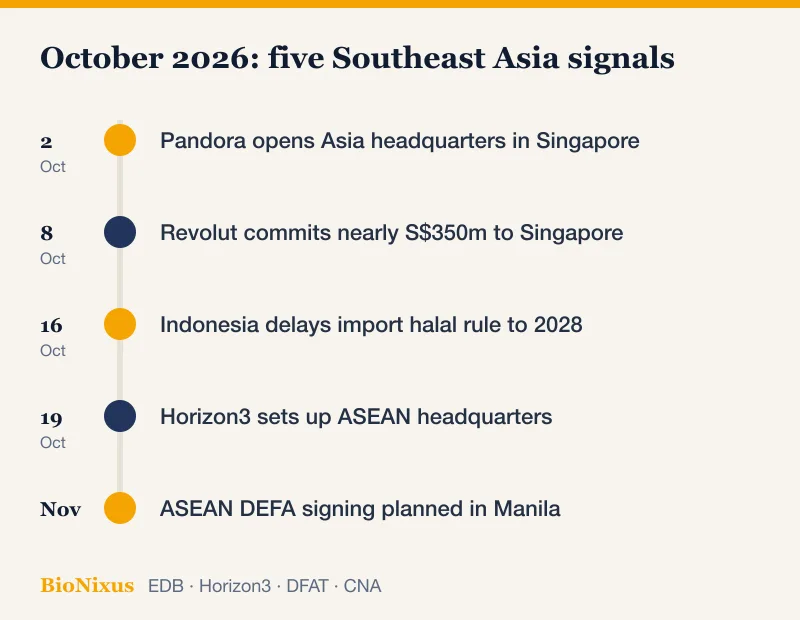
Pandora opened its Asia headquarters in Marina Bay on 2 October 2026, with around 50 staff in branding and marketing, market development and operations (Pandora via EDB).
The hub oversees a mix of owned-and-operated stores and distributor markets. Its chief executive said the office would help teams “listen, learn and respond to the incredible diversity of this region” (Pandora via EDB).
On 8 October, Revolut committed nearly S$350 million to Singapore over five years and called the city an important base for its Southeast Asian expansion (Revolut via EDB). On 19 October, Horizon3 set up its ASEAN headquarters there, with plans to grow through local service providers and systems integrators (Horizon3).
All three describe Singapore as a place to run a region from. None of them describes it as a test market for the region. That distinction is the starting point for entry research.
The border is where the rules change
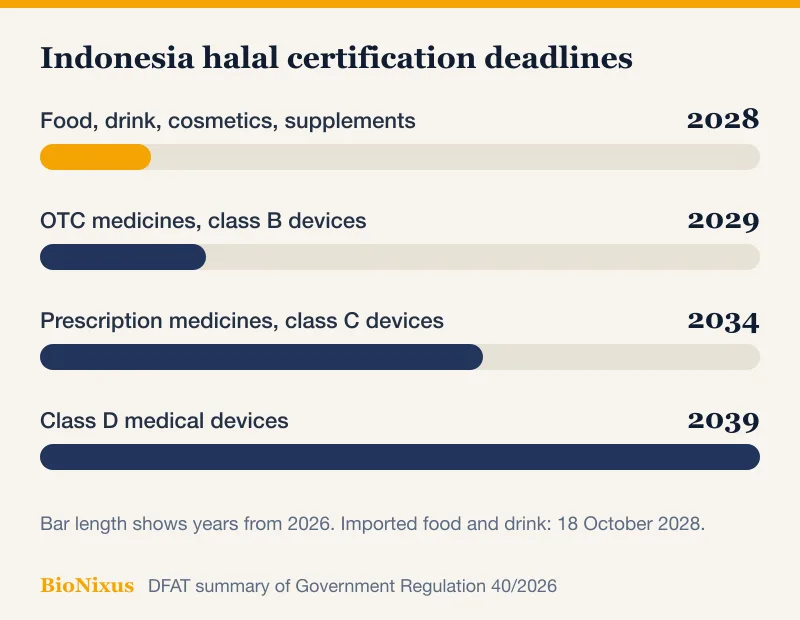
Indonesia shows how quickly the ground can move. On 16 October 2026, it delayed expanded mandatory halal certification for imported products from October 2026 to 18 October 2028, through Government Regulation 40/2026 (DFAT).
Halal certification confirms that a product and its supply chain meet Islamic dietary and handling rules. Under Indonesia’s law, exporters will need certified products, fully separate halal supply chains, new labels, and an importer who registers the certificate on the SiHalal portal (DFAT).
The same regulation revoked a halal pre-shipment inspection rule that had worried exporters (DFAT). Indonesia’s government said the delay gives businesses and the halal ecosystem more time to prepare (ANTARA).
The dates differ by product. Food, drink, cosmetics and supplements fall due in 2028; over-the-counter medicines in 2029; prescription medicines in 2034 (DFAT).
A brand that sells easily in Singapore can face a different product file, label and partner model in Jakarta. Desk research finds the rule. Research with importers and distributors finds what the rule costs and who will carry it.
What ASEAN DEFA will and will not change
ASEAN officials concluded negotiations on the Digital Economy Framework Agreement (DEFA) in May 2026. It covers digital trade, cross-border e-commerce, data governance, digital identity, electronic payments and online safety (ASEAN).
ASEAN says its digital economy could reach about US$1 trillion by 2030 on current trends, and that studies suggest DEFA could double that to US$2 trillion (ASEAN). That second figure is a projection, not a forecast to plan on.
Philippine President Ferdinand Marcos Jr said the agreement would be formalised at the 49th ASEAN Summit in Manila in November (CNA).
DEFA should make digital selling and payments across borders easier. It does not merge consumer tastes, retail channels, product registration or halal rules. Those stay national, and so does most of the research.
What to validate in each market
Four questions need a separate answer in every target market.
Demand: who buys, how often, and what they use today. A product category that is established in Singapore may be new, or already crowded, in Manila or Ho Chi Minh City.
Channels: whether buyers reach you through modern retail, traditional trade, marketplaces, distributors or direct sales. Traditional trade means small independent shops, and its weight varies from one market to the next.
Regulation: registration, labelling, certification and local-partner rules, checked against the dates that apply to your product, not to the category in general.
Price: what buyers will pay after duties, distributor margins and local competitors. A Singapore price is rarely the right reference.
A research sequence that works
Start with a short desk screen of the candidate markets to rank them on size, access and fit. Then talk to the people who control the route to market: importers, distributors, retailers and, for B2B products, the buyers inside target companies.
Next, run quantitative work with end buyers in the top one or two markets to size demand and test price. Only then plan the rollout, market by market, with the rules and partner terms you have confirmed.
The order matters. Surveying consumers before you know which channel will carry the product often answers the wrong question.
Using the Singapore team in the research
A regional headquarters team is a stakeholder, not a respondent. Interview them first, to capture what they already know about each market and where they disagree.
Then test their assumptions with people outside the company. Regional teams often know the distributors well and the end buyers less well. Good entry research shows them both views side by side.
When to add the Middle East
Many Singapore-based teams also look west, to the Gulf. The question to ask is whether the Southeast Asia rollout is stable enough to share management attention with a second region.
The Gulf has its own entry logic: different buyers, different regulators and different channel partners. Our playbook for market entry research in Saudi Arabia covers what to validate there.
Our take
Choosing Singapore as a base is usually the right call, and October’s announcements show why companies keep making it. The mistake is treating the Singapore result as the regional result.
Entry research should begin at the border of each target market: with its rules, its channel partners and its buyers. Indonesia’s halal delay is a reminder that those rules can change in a single announcement.
How we deliver Asia-Pacific research
BioNixus delivers Asia-Pacific projects from our US, UK and Cairo offices, with our Dubai-based field team. We do not have an office in Singapore.
What to watch
Watch the DEFA signing at the ASEAN Summit in November, and the national rules that follow it. Watch Indonesia’s implementing rules for halal certification before the 2028 deadline. And watch which other companies choose Singapore for regional headquarters, and which markets they put under them.
What entry teams should do now
Rank your target markets on demand, access and fit before you commission fieldwork.
Validate demand in each market separately, not from the Singapore result.
Interview importers and distributors early, because they control the route to market and know the real cost of local rules.
Test prices locally, after duties and margins. Then plan a phased entry, one or two markets at a time.
If you are planning a Southeast Asia entry from Singapore, or a move from Singapore into the Middle East, BioNixus can scope the market-by-market research through our Singapore market research team. We were founded in 2012 and have worked with 118 clients in 48 countries.
References
- Pandora via Singapore EDB. Pandora officially opens Asia headquarters in Singapore. 2 October 2026. Source.
- Revolut via Singapore EDB. Revolut announces new Collyer Quay office as it commits nearly S$350 million to Singapore. 8 October 2026. Source.
- Horizon3. Horizon3 expands in Singapore to accelerate AI-native proactive security across Southeast Asia. 19 October 2026. Source.
- Australian Government, Department of Foreign Affairs and Trade. Complying with Indonesian halal requirements. Updated October 2026. Source.
- ANTARA News. RI extends halal certification mandate for select sectors to Oct. 2028. October 2026. Source.
- ASEAN. Statement of the Chairperson of the ASEAN Senior Economic Officials on the conclusion of ASEAN DEFA negotiations. 30 May 2026. Source.
- CNA. Landmark ASEAN digital pact will guide region on AI, digital economy: Marcos. 8 October 2026. Source.