What the shipment data shows
The whole market is shrinking. Omdia counted 10.6 million smartphone shipments in the Middle East, excluding Turkey, in the second quarter of 2026, down 19% on a year earlier (Omdia).
Price is the main reason. Shipments of phones priced under $200 fell 42%, and Omdia said vendors were moving upmarket while retailers held less stock (Omdia).
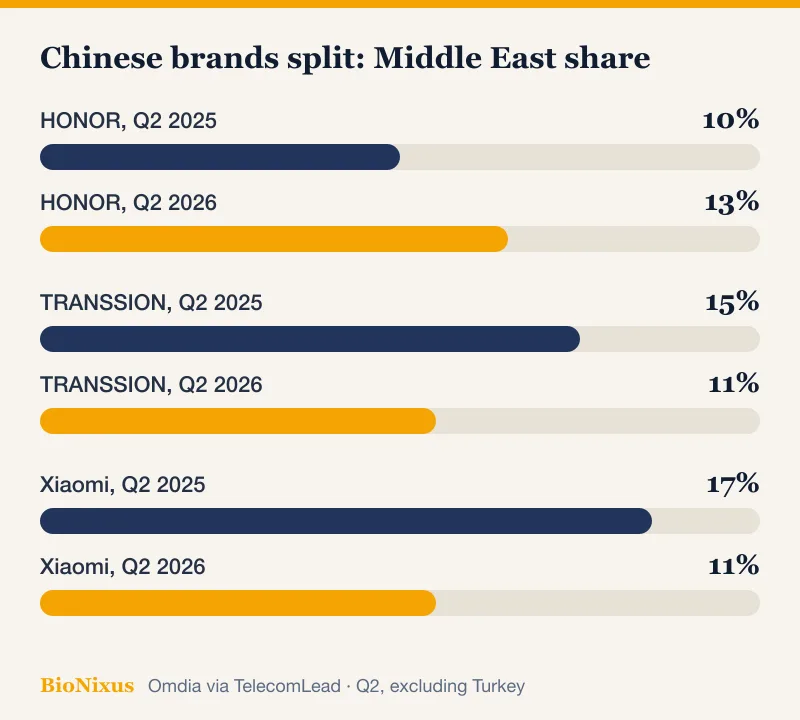
The Chinese brands responded differently. HONOR grew 2% in the quarter and stayed second, behind Samsung’s 39% share. TRANSSION’s shipments fell 40% and Xiaomi’s fell 50% (Omdia).
In share terms, HONOR rose from 10% to 13%, while TRANSSION fell from 15% to 11% and Xiaomi from 17% to 11% (TelecomLead).
Across the first half, HONOR’s shipments rose 35% while the market fell 13%, according to Omdia data supplied by the company (Gulf News).
The launches have not stopped. Huawei released its nova 16s series in Saudi Arabia on 26 October from SAR 1,999, and HONOR launched the X9e Pro in the UAE on 30 October from AED 1,499 (Saudi Teqnia; PCMag Middle East).
Awareness is not preference
When Omdia explained HONOR’s rise to second place in the first quarter, it pointed to retail execution, wider distribution and “improving brand perception across Gulf markets” (Omdia).
Only the first two can be read from shipment data. Brand perception has to be measured by asking buyers, and none of the public data does that.
This matters because shelf space and preference can come apart. A brand can gain distribution, run strong launch offers and ship more units while buyers still see it as a second choice. When prices rise, as they are now, that second choice is the first to be dropped.
The split between HONOR and Xiaomi shows why. Omdia linked Xiaomi’s and TRANSSION’s declines to pressure on their cost-performance positioning among budget buyers (Omdia). Whether buyers now see those brands differently, or simply cannot afford them, is a question only research can answer.
What a brand tracker measures
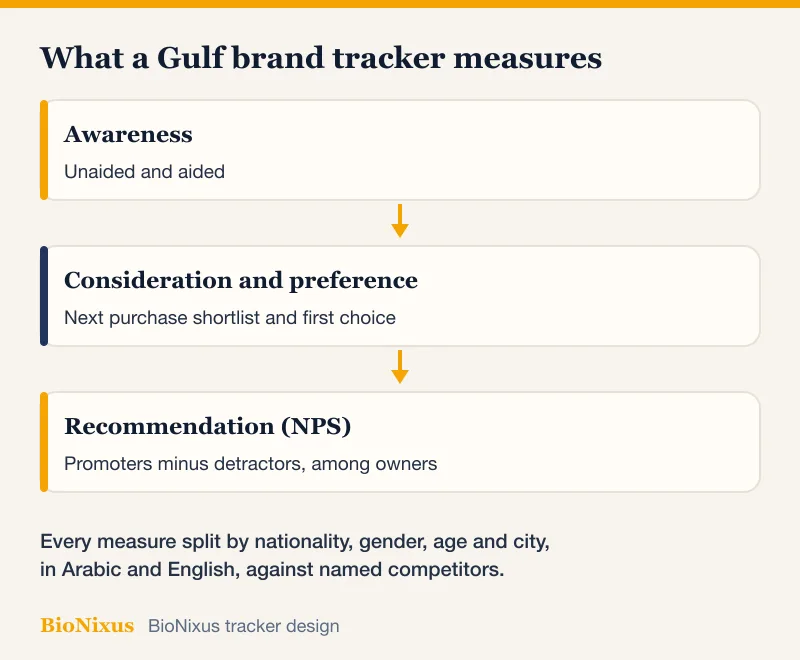
A brand tracker is a survey repeated at regular intervals with the same questions, so that changes over time can be read with confidence. It usually follows a funnel.
Awareness comes first. Unaided awareness asks buyers to name brands without prompting; aided awareness shows them a list. The gap between the two shows how far a brand is front of mind.
Consideration asks which brands a buyer would look at for their next purchase. Preference asks which one they would choose. Purchase intent asks how likely they are to buy it.
Net Promoter Score (NPS) measures recommendation. Owners rate how likely they are to recommend the brand from 0 to 10, and the score is the share of promoters minus the share of detractors.
Brand image questions sit beside the funnel. For phones, they usually cover value for money, camera, battery, durability, software updates and after-sales service, which are the claims Chinese brands lead with.
The value of a tracker is in the comparisons: your brand against competitors, and this wave against the last. A single survey shows a position. Repeated waves show a direction.
What is different about the Gulf
The population is not one market. In Saudi Arabia, 55.6% of residents in mid-2024 were Saudi citizens and 44.4% were not (GASTAT).
The non-Saudi population is also mostly male: about 12.1 million men against 3.6 million women (GASTAT). A survey sample that simply mirrors the population would therefore be dominated by expatriate men, which may not be the buyer a brand wants to read.
Set quotas by nationality group, gender, age and city instead, and weight the results to the buyer profile you care about. Report nationals and expatriates separately, because their incomes, channels and brand histories differ.
Language matters too. Run fieldwork in Arabic and English as a minimum, and add other languages where a large expatriate group is a target.
The calendar shapes buying. Omdia noted that brands front-loaded stock before Ramadan in 2026, and that Kuwait was steadied by its February shopping festival (Omdia). Time tracker waves so that seasonal peaks do not look like brand changes.
Prices also differ by country. Omdia expects affluent Gulf markets to keep favouring premium phones through financing, trade-ins and flagship launches, while more value-conscious markets delay upgrades (Omdia). Read the UAE and Saudi Arabia separately from Kuwait, Qatar or Oman.
Setting up a Gulf tracker
Start with a baseline wave before a major launch or campaign. Without it, there is nothing to compare later waves against.
Track quarterly. That is often enough to catch launch effects and price changes, and not so often that normal survey noise looks like movement.
Keep the questionnaire stable. Changing the wording of a core question breaks the trend line, so add new questions around the core rather than rewriting it.
Make the sample large enough to read each segment you plan to report. If headquarters wants Saudi nationals and expatriates reported separately, each group needs its own robust base, not a slice of a small total.
Agree the KPIs before fieldwork: for example unaided awareness, consideration, preference and NPS, each against two or three named competitors. Our page on brand tracking in the GCC sets out the wave method we use with pharmaceutical brands, and our guide to brand tracking in Dubai covers choosing an agency.
How this fits Chinese brands in the Gulf
Phones are one part of a wider shift. We have looked at how Chinese EV brands are seen by Saudi and UAE buyers, and at the research Chinese companies need when entering Saudi Arabia and the UAE.
The pattern is similar across categories. Distribution and launch spending move fast; trust, preference and repeat purchase move slowly and need to be measured directly.
Our take
The Gulf phone market is shrinking and getting more expensive. In that market, brands that buyers actively prefer will hold up better than brands that won on price and shelf space.
HONOR’s rise and Xiaomi’s fall show that Chinese brands are not one group in buyers’ minds. A tracker is the only way to see which way each brand’s reputation is moving before it shows up in shipments.
What to watch
Omdia’s 29 October release reported the regional decline but no Middle East brand shares for the third quarter (Omdia). Watch for that regional breakdown, which will show whether HONOR held second place. Watch new Chinese launches and retail partnerships in Saudi Arabia and the UAE through the holiday season. And watch prices, because further component cost increases will test how much preference each brand has built.
What brand teams should do now
Set baseline KPIs with a first wave before your next launch.
Segment by nationality, gender and age, and report nationals and expatriates separately.
Track quarterly, with a stable core questionnaire.
Compare against named competitors, Chinese and non-Chinese, in every wave.
Agree the reporting language with headquarters early; many Chinese brands need results in Chinese as well as English.
If your brand needs a Gulf tracker, BioNixus can set up a baseline wave through our industry market research team. We were founded in 2012, have worked with 118 clients in 48 countries, and run Gulf fieldwork from our US, UK and Cairo offices with our field teams in the UAE and Saudi Arabia. We do not have an office in China.
References
- Omdia. Global smartphone shipments fell 20% in 3Q26, the lowest third-quarter total since 2013. 29 October 2026. Source.
- Omdia. Middle East smartphone market falls 19% in 2Q26 amid vendors prioritize profitability. 12 August 2026. Source.
- Omdia. Middle East smartphone market expected to decline 22% after weak start to 2026. 21 May 2026. Source.
- TelecomLead. Middle East Smartphone Market Drops 19% as Premium Devices Lift ASP to Record $448. August 2026. Source.
- Gulf News. HONOR Grows 35% in Middle East as Smartphone Shipments Drop 13% in H1 2026. 24 August 2026. Source.
- Saudi Teqnia. HUAWEI nova 16s Series available now in the Kingdom of Saudi Arabia. 26 October 2026. Source.
- PCMag Middle East. HONOR X9e Pro launches in UAE with massive 11,000mAh battery for AED 1,499. 30 October 2026. Source.
- General Authority for Statistics (GASTAT), Saudi Arabia. Population Estimates Statistics 2024. Source.