What China biotech export controls would add to the list
Announcement No. 48 is a joint MOFCOM and MOST notice. It proposes adding 40 technologies and starts interim pre-export registration the same day (MOFCOM bulletin; MOFCOM disclosure copy).
The legal basis is already on the books. The Foreign Trade Law, in force from 1 March 2026, lets the State write catalogues of technologies that may not leave, or may leave only with a licence (Foreign Trade Law; MOFCOM policy database). Restricted technology is licensed. Prohibited technology may not be exported (State Council regulations; MOFCOM copy; 2020 reprint).
The notice lists 23 AI items, including large models, intelligent agents and computing clusters. Public-domain AI is out of scope. It lists five biomedicine items — cell and gene therapy, small nucleic-acid drugs (the Chinese term covers siRNA) and some germ-related technology — and 12 photovoltaic items. The 40-item headline is not “40 biotech items” (Announcement No. 48; China Daily).
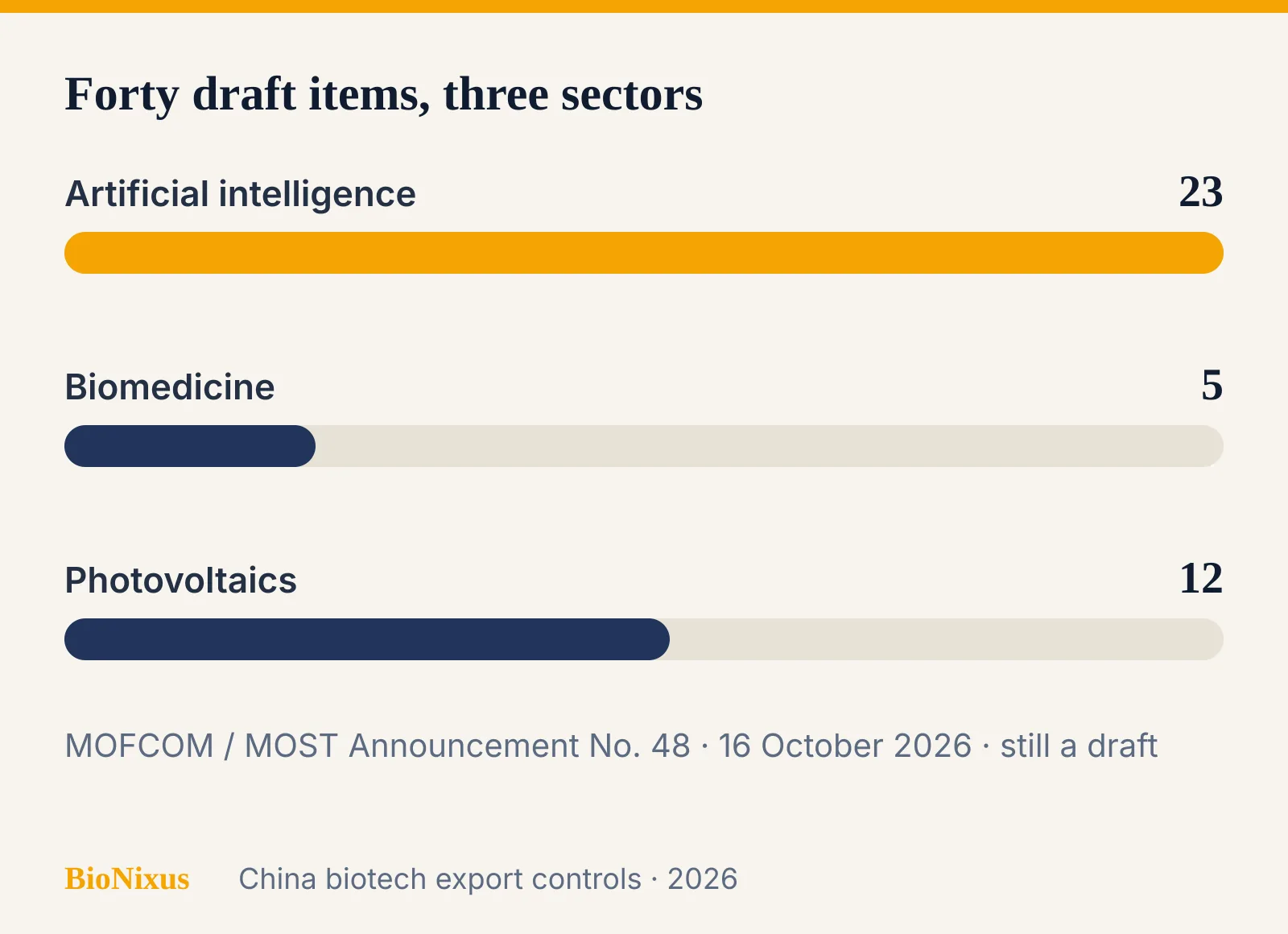
China Daily said 14 of the 40 would be prohibited and 26 restricted. Treat that as a report of the draft, not as Annex 1 (China Daily). Reuters reported a ministry statement that the revision is routine and does not target any specific country, region or entity (Reuters). Until you have read Annex 1 against a named asset, “in scope” is a hypothesis.
A sale of the platform is the hard case
The draft is not a blanket ban on Chinese biotech leaving the country. It is a ban-or-licence rule aimed at the reusable engine.
Outbound authorisations that do not transfer ownership can use automatic licensing and other facilitation (MOFCOM). Fierce Biotech quoted Aaron Gu of Han Kun as “regulating transfers while leaving licensing unconstrained.”
A MOFCOM spokesperson said out-licensing and the use of know-how for outsourced research and manufacturing do not fall under the ban. As of 1 July 2026, only five of 121 cross-border Chinese biopharma out-licensing deals that year involved an ownership transfer, according to PharmCube as cited by Fierce (Fierce Biotech)
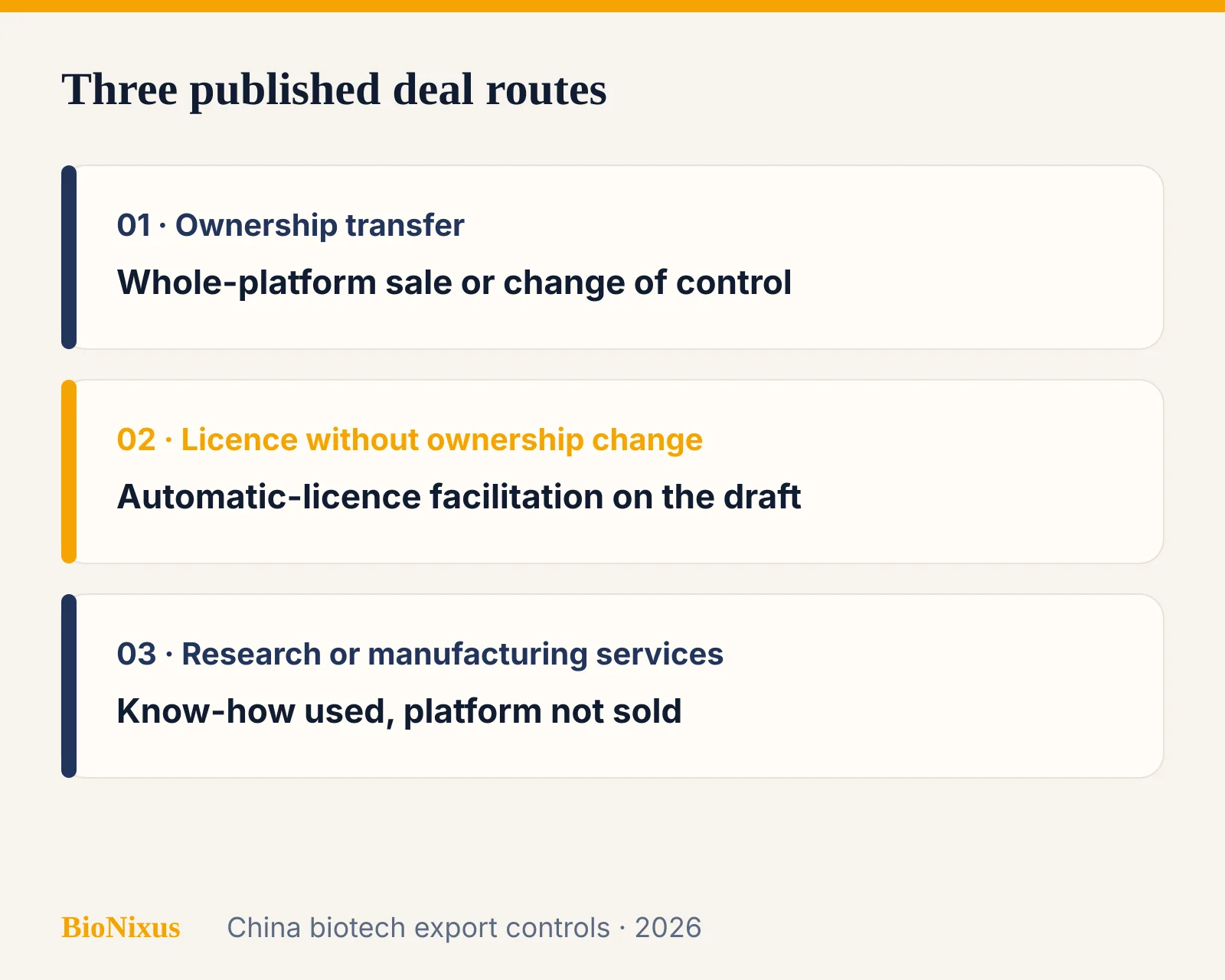
“Licence” on a slide is not enough if the contract is in substance a sale or a change of actual control. That is its own registration case (Announcement No. 48, section 3).
A CRO or CMO contract is not a platform acquisition. Even an open licence still has paperwork. During the interim period, outbound licensing of listed technology is one of the four registration cases (unified platform).
Ask counsel to label the live term sheet. Then commission the research around that label. This is not legal advice.
The AstraZeneca–Gracell deal is the cautionary example
On 26 December 2023 AstraZeneca agreed to acquire Gracell Biotechnologies for about $1.0 billion upfront, or about $1.2 billion if a contingent value right is paid (AstraZeneca, 26 December 2023; AstraZeneca Form 6-K).
The assets included GC012F and Gracell’s FasTCAR manufacturing platform, treated as a reusable engine. The deal closed on 22 February 2024 (AstraZeneca, 22 February 2024; AstraZeneca Form 6-K; Gracell).
Fierce said that purchase “would likely not have been possible under the proposed new rule” (Fierce Biotech). That is Fierce’s judgement, not a MOFCOM ruling. If the live deal looks more like Gracell than a molecule licence, ask what structure still moves the asset.
Registration is already live
Two clocks are running. Only one of them is a comment clock.
Comments run from 16 October to 15 November 2026. Submissions go to jinxianmulu@mofcom.gov.cn. An organisation must stamp its comments (Announcement No. 48)
The registration clock started the day the notice was published. Until a revised catalogue takes effect, a listed export must be registered on MOFCOM’s unified business platform before it leaves. Exports that have already started but have not finished are in scope (ecomp.mofcom.gov.cn; Reuters)
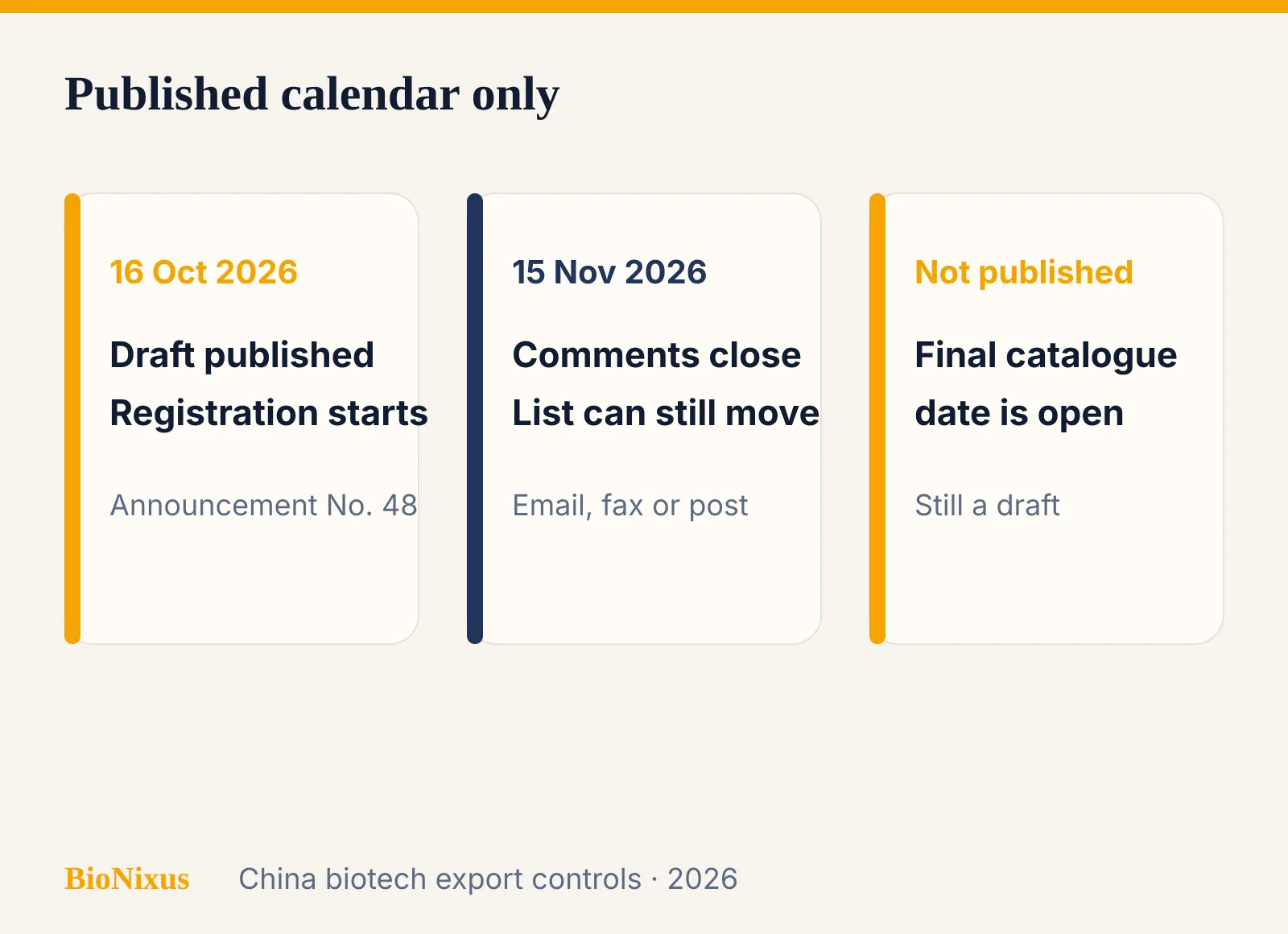
The filing cases include ownership transfer, outbound licensing, and a change of owner or actual controller to an overseas party (Announcement No. 48). A team that waits for 15 November before opening that file is already late.
Our take
The draft is not a shutdown of China-origin innovation. It is a preference for licences over platform sales.
China still wants the medicine to travel. It wants to keep more of the machine that makes the next one. Fierce reported $120 billion in foreign transactions of Chinese biotech assets as of August 2026, up 36% year on year, citing China’s drug regulators (Fierce Biotech). Most of those deals were licences or product purchases, not platform sales.
Counsel on the other side says the published draft is narrower than a May rumour that had included ADCs and protein degraders. Gu of Han Kun called the text “significantly better than market expectations.” If most 2026 deals were already licences, a rule aimed at platform sales may change fewer closings than the headline. A Gracell-style purchase of the engine is still the hard case.
IQVIA, Evaluate and Clarivate sell China biopharma deal pages. They do not say whether your asset sits on the five biomedicine items. Diligence the asset, not the sector headline.
What China biotech export controls change for a Gulf launch
The deal structure and the launch file are now two linked problems. A licence that keeps the platform in China can still put a named cell, gene or siRNA product into a Gulf plan. A platform sale that cannot close can break that plan if the manufacturing engine sat inside the company you meant to buy.
Physician and payer evidence in Riyadh is not evidence in Dubai. See healthcare market research in Saudi Arabia and healthcare market research in the UAE.
CAR-T Saudi Arabia market research covers centre gates. Hematology market research in Saudi Arabia covers sickle cell and gene-therapy access. This page does not repeat those series.
If the product or the engine is China-origin, the BD structure and the MOFCOM registration status belong in the same brief as the centre map. A China HCP tracker is not a Gulf treated-share. That file sits with our healthcare market research work across the region.
What to watch before 15 November
Comments close on 15 November 2026. The list, the thresholds and the facilitation rules can still move (MOFCOM; Reuters).
Watch whether the final catalogue keeps the 14 / 26 split China Daily reported, and whether Annex 1 names your class with a tighter threshold. A final catalogue date has not been published. The comment window can change the list. The registration duty is not waiting.
What deal, licensing and Gulf access teams should do now
Map the named asset onto the five biomedicine items, the 23 AI items, or neither. The notice names classes, not your molecule.
Ask counsel to label the live term sheet: platform sale, licence that keeps ownership in China, change of actual control, or service contract. Favour a licence or a co-development when the asset looks like a platform (MOFCOM; Fierce).
Ask whether the Chinese counterpart has already registered the export, including unfinished work. Put extra time in the clock (State Council regulations). Write a backup if the launch sits on one Chinese platform.
If Saudi Arabia or the UAE is in the first wave, interview physicians and payers as separate samples and name the centre.
If you need that catalogue map, licence-versus-sale screen or Gulf treated-share before 15 November, BioNixus can scope it from US, UK, Dubai and Cairo offices on Middle East market research for Chinese companies. Founded in 2012: 118 clients, 48 countries, 127 studies in 2026, about 3,200 physicians, typical custom pricing $10k–$60k. Sheridan, London and Cairo are leadership offices; Dubai, Al Khobar and Salmiya, Kuwait are field offices; it is in the process of opening a São Paulo office by the end of 2026. BioNixus does not have a China office. Guaranteed in writing covers scope and timeline, not findings. It has 40 client reviews.
References
- MOFCOM/MOST Announcement No. 48 (16 October 2026). Draft add of 40 technologies; comments to 15 November. Source.
- MOFCOM disclosure copy of Announcement No. 48 of 2026. Same 16 October bulletin. Source.
- Reuters, via Yahoo News. China proposes adding 40 AI, biotech, solar technologies (16 October 2026). Source.
- Liu A. China looks to ban foreign acquisitions of critical biopharma platforms. Fierce Biotech. 16 October 2026. Source.
- Zhang C. Draft revision aims to better streamline tech exports. China Daily. 17 October 2026. Source.
- MOFCOM Unified Business Platform. Technology Trade Management Information application. Source.
- Foreign Trade Law of the People’s Republic of China (2025 revision). In force 1 March 2026. Named in Announcement No. 48. Source.
- MOFCOM Policy Law database. Foreign Trade Law (2025 revision), Presidential Order No. 67. Source.
- State Council. Regulations on the Administration of Technology Import and Export. Official gazette reprint. Source.
- MOFCOM copy of the Regulations on the Administration of Technology Import and Export. Source.
- AstraZeneca. AstraZeneca to acquire Gracell. 26 December 2023. About $1.0 billion upfront; about $1.2 billion with CVR. Source.
- AstraZeneca. Acquisition of Gracell completed. 22 February 2024. Source.
- AstraZeneca PLC. Form 6-K, 26 December 2023. Gracell announcement filed with the SEC. Source.
- AstraZeneca PLC. Form 6-K, 22 February 2024. Gracell close filed with the SEC. Source.
- Gracell Biotechnologies. Acquisition completed. 22 February 2024. Source.
- Zhejiang Provincial Department of Commerce reprint. Technology import and export regulations, 2020 third revision. Source.
- IQVIA. China and cross-border biopharma deal commentary. Not a named-asset catalogue screen..
- Evaluate. Syndicated biopharma deal products. Not a MOFCOM-catalogue or Gulf payer file..
- Clarivate. Syndicated pipeline and deal intelligence. Does not label a live term sheet..