
A Dubai Essential Drug List formulary submission is a research problem before it is a portal upload. Manufacturer affiliates searching that phrase are usually trying to get a product onto the reimbursable outpatient list that sits under Dubai’s mandatory health insurance. Official DHA and ISAHD pages do not publish a document titled “Dubai Essential Drug List” or the acronym DEDL. They publish a weekly Dubai Drug Code, an Essential Benefits Plan whose medicines line is “restricted to formulary products where available,” and — at federal level — a 2025 National Essential Medicines List. What a brand, HEOR or local-affiliate team still cannot buy off the shelf is which of those lists the forecast is using, which wallet will fund the script after a code exists, and what local evidence a UAE payer will accept beside the global RCT. This briefing uses only published sources. It sits alongside our healthcare market research company hub for Saudi Arabia, the UAE and the GCC.
Quick facts: Dubai listing layers, October 2026
- Law No. 11 of 2013 makes health insurance mandatory in Dubai, including free zones such as DIFC; DHA approves packages, prices and co-insurance (Law 11/2013; Dubai.ae).
- Essential Benefits Plan is the minimum standard for any health-insurance policy issued in Dubai. From 1 January 2025 the medicines line is AED 2,500 a year including coinsurance, 30% per prescription, restricted to formulary products where available (GC 03/2024).
- AED 1,500 was the previous EBP medicines cap in PD 01/2021 (PD 01/2021). Do not mix the two vintages.
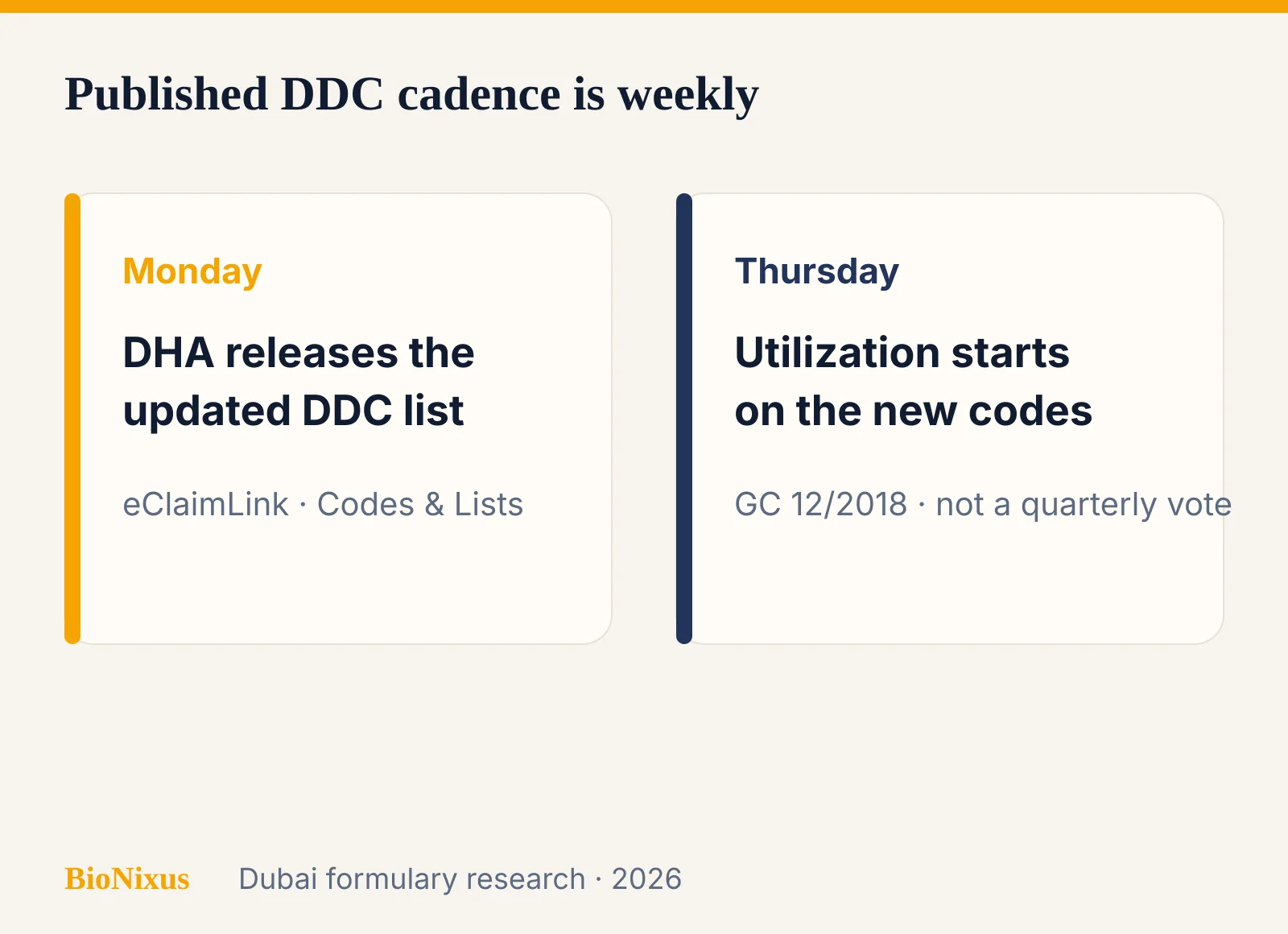
- Weekly, not quarterly, on the public DDC calendar: DHA Pharmacy Services releases Dubai Drug Code updates every Monday; utilization starts on Thursday (GC 12/2018; eClaimLink).
- Twenty Participating Insurers were permitted to sell the EBP to the low-salary band for calendar year 2025 (GC 06/2024).
- 19 June 2025: EDE Chairman Decision No. 47 of 2025 adopted the UAE National Essential Medicines List (EDE)
- 5 January 2026: MOHAP transferred 44 core services in full to EDE, including individual-product re-pricing and publication of regulated-medicine price lists (MOHAP)
- 11.29 million residents in 2024 (FCSC Unified UAE Numbers). That is a population, not a treated-patient count.
What is a Dubai Essential Drug List formulary submission?
It is the commissioned file that tells a manufacturer affiliate whether a product will receive a Dubai Drug Code, whether an insurer will treat it as a formulary product under the Essential Benefits Plan or an enhanced policy, and whether a Dubai hospital formulary will stock it. It is not a syndicated UAE pharmaceutical market-size slide, and it is not a federal price certificate.
Grand View Research, IMARC Group and IQVIA sell UAE pharmaceutical outlooks that often occupy this query. They do not say whether the SKU has a DDC code, sits inside the AED 2,500 EBP cap, or will be added by a facility committee. Country context sits on healthcare market research in the UAE and UAE pharmaceutical market research.
Affiliate teams often plan to a quarterly committee calendar. The public DHA record cited here does not name a quarterly “DEDL committee” or a 60-day filing window. What it does name is a weekly DDC release, EBP Table of Benefits updates by dated circular, and facility formularies that a multidisciplinary committee may create (GC 12/2018; GC 03/2024; DHA Pharmacy Guidelines 2021). Commission the brief to the published cadence. Do not invent a committee that is not on a current public circular.
A usable Dubai Essential Drug List formulary submission file usually needs a four-list map (GC 12/2018; EDE Decision 47/2025), the pharmaceutical-company DDC pack eClaimLink still asks for (eClaimLink), payer interviews that split Participating Insurers from enhanced-plan medical directors (ISAHD; GC 06/2024), and Arabic plus English instruments in Dubai and at least one comparison emirate.
The unit of observation is the code, the benefit line and the facility committee, not a vial forecast. Compare healthcare market research in Saudi Arabia and Kuwait rather than importing an SFDA listing into a Dubai insurance file.
Which published lists sit behind that search term?
Four published lists now sit where industry slides write “DEDL”. They are not one list.
The Dubai Drug Code is the comprehensive list of all drugs registered with DHA’s Pharmacy Services department. GC 12/2018 assigns each registered drug a unique code that already includes route, dosage, form, pack size, price, manufacturer, registered owner and source — MOH, DHA or private hospital (GC 12/2018). eClaimLink still publishes that list as a current coding set (eClaimLink). A DDC code is how a payer and a provider identify the SKU on a claim. It is not, by itself, a promise that the Essential Benefits Plan will pay.
The Essential Benefits Plan Table of Benefits is the minimum standard for any health-insurance policy issued in Dubai. GC 03/2024, dated 23 July 2024 and in force from 1 January 2025, writes the medicines line as: cost of drugs and medicines up to an annual limit of AED 2,500 including coinsurance; restricted to formulary products where available; 30% payable by the insured on each and every prescription; no cover for drugs and medicines in excess of the annual limit (GC 03/2024). The circular does not attach a public molecule list. The restriction is the published rule. The list that implements it is the research question.
The UAE National Essential Medicines List is a federal essential-medicines instrument, not a Dubai insurance formulary. EDE Chairman Decision No. 47 of 2025, dated 19 June 2025, adopted the 2025 NEML (EDE legislations page; EDE NEML attachment; DHA-hosted Decision 47/2025 PDF). WHO posted an English 2025 NEML file dated 3 June 2026 (WHO). A molecule can sit on the NEML and still lack a DDC code, or the reverse.
A facility formulary is a hospital or clinic list. DHA’s 2021 Pharmacy Guidelines define a formulary as the medications the healthcare organization or facility has decided may be prescribed and ordered. The pharmacy should create that list; a drug formulary may be created by a multidisciplinary committee; selection is based on efficacy, safety, economics and the services the facility provides; the medication-management system is to be reviewed at least once within 24 months (DHA Pharmacy Guidelines 2021). That 24-month review is the closest published review cadence for a Dubai facility list. It is not a quarterly emirate-wide vote.
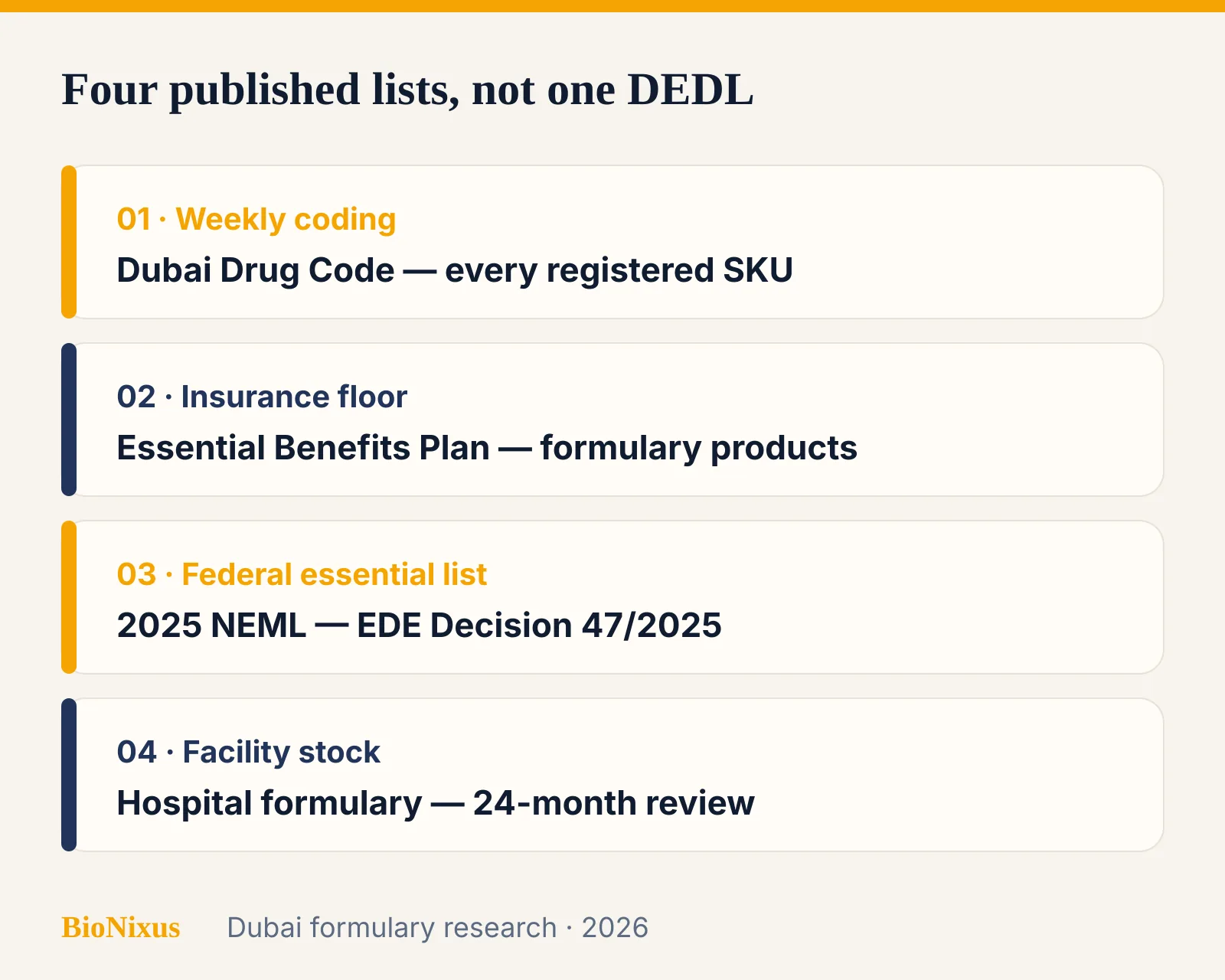
A Dubai Essential Drug List formulary submission that collapses those four layers into one “listed / not listed” cell will be sent back the first time a medical director asks which list the model used.
What does the Essential Benefits Plan actually pay for?
Law No. 11 of 2013 is the statute. It applies across the Emirate, including special development zones and free zones such as the Dubai International Financial Centre. Article 5 gives DHA the duties to pre-qualify insurers and to approve health-insurance packages, their prices and co-insurance. Article 7 requires the entities determined in Article 9 to enrol UAE nationals, residents and visitors (Law 11/2013). Dubai.ae states the operational reading: employers, including free-zone employers, must cover employees; sponsors must cover dependents; Dubai citizens and government employees are eligible under Enaya (Dubai.ae). The UNDP / Gulf Health Council NCD investment case describes Dubai’s Saada programme beside Abu Dhabi’s Thiqa programme and employer-mandated cover for expatriate employees (UNDP NCD investment case).
ISAHD’s Participating Insurers page writes the coverage floor in one sentence: the Law requires all residents to have a level of health insurance that meets or exceeds the minimum benefits stipulated by DHA, and those benefits form the Essential Benefits Plan. Only Participating Insurers may sell that plan to residents earning AED 4,000 or less per month (ISAHD; ISAHD Employer Pack)
GC 06/2024 named twenty Participating Insurers permitted to provide the approved EBP for the low-salary band from 1 January 2025 to 31 December 2025, including Dubai Insurance, Orient, GIG AXA, Sukoon, MetLife, ADNIC, Liva, Medgulf and Cigna’s Dubai branch (GC 06/2024). That list is a 2025 permit. A 2026 brief should ask which current circular replaced it. It should not treat the twenty names as a permanent roster.
The medicines arithmetic changed once in the public record this decade. PD 01/2021 set the EBP drugs line at AED 1,500 a year including coinsurance (PD 01/2021). GC 03/2024 raised that annual limit to AED 2,500 from 1 January 2025, restated the 30% coinsurance and the formulary restriction, set the Index Rate band at AED 550–750 per member per year plus VAT (± AED 25), and kept an annual upper aggregate claims limit of AED 150,000 (GC 03/2024).
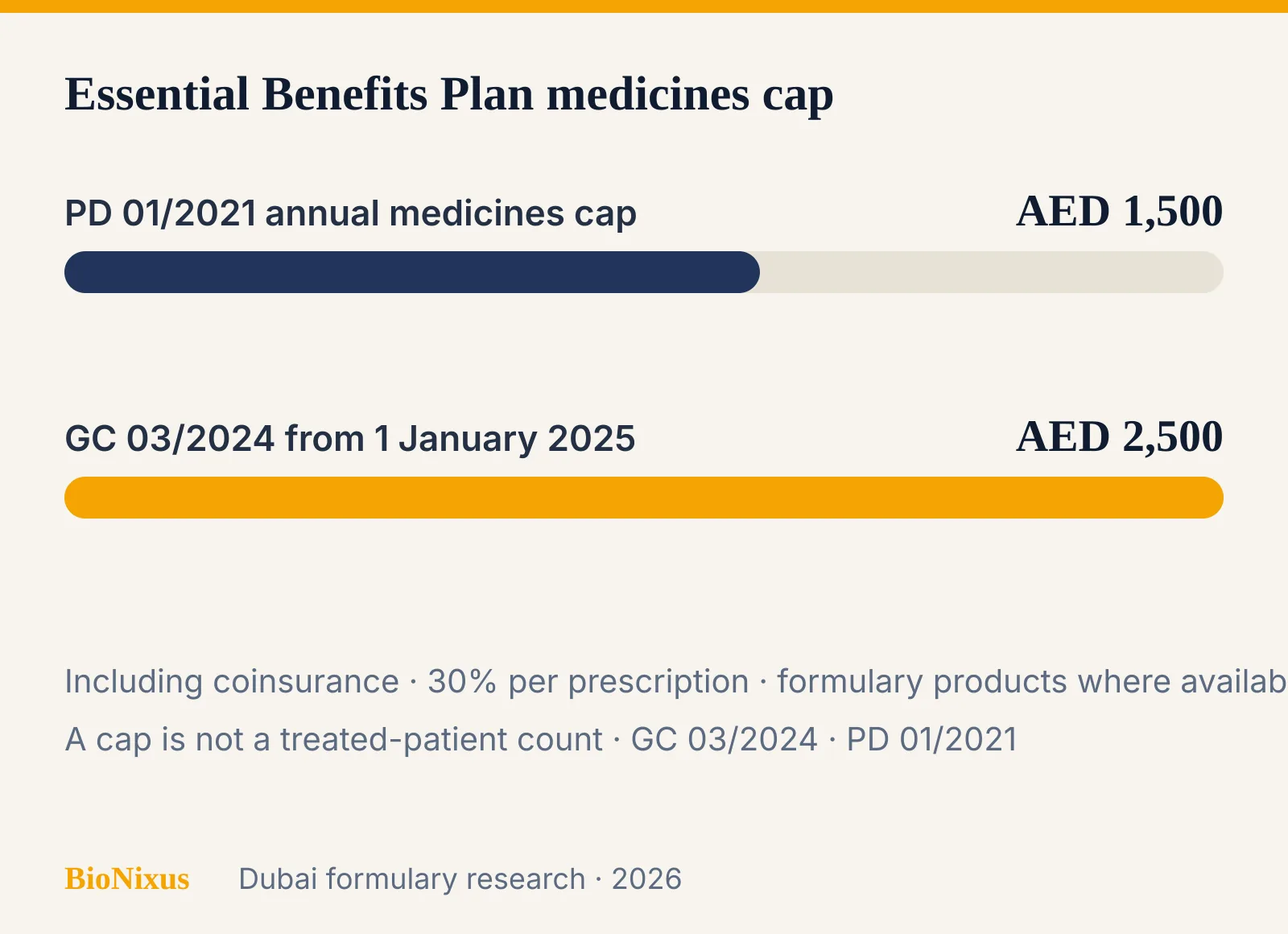
Three research points sit inside that medicines line. First, the EBP is the minimum for any Dubai policy, not only the low-salary product (GC 03/2024). An enhanced plan can pay more, but it cannot pay less than this floor. Second, “restricted to formulary products where available” is the published gate. The circular does not publish the molecule list that implements it. Third, AED 2,500 including 30% coinsurance is a small annual pharmacy budget for a specialty SKU. A product that will never fit inside that cap is not an EBP play. It is an enhanced-plan, hospital-inpatient or self-pay play. Those are three different interviews.
On 7 October 2025 the Dubai Health Insurance Corporation told the market that new Policy Directives revoke and replace a named set of earlier ISAHD circulars (GC 05-2025). The insurance regulator a 2026 brief writes to is DHIC as well as DHA Pharmacy Services. A cover letter that still addresses only a 2018 coding desk is already incomplete.
How does a product get a Dubai Drug Code?
eClaimLink publishes the pharmaceutical-company steps. The company downloads the DDC registration form, fills every field, and emails DHA Pharmacy Services with the form, a MOH product-registration certificate for a MOH-registered item — or a MOH receipt of the registration file for an item still under registration — and an updated invoice showing cost and selling prices. Pharmacy Services accepts and assigns a code, rejects with reasons, or asks for more information. Updates release every Monday. The updated list is available on eClaimLink under DHD > Codes & Lists > Dubai Drug Code. Utilization starts on Thursday (eClaimLink DDC registration; GC 12/2018)
Two 2026 facts now sit on that form. First, the public page still says “MOH product registration certificate.” On 5 January 2026 MOHAP transferred 44 core services in full to the Emirates Drug Establishment, including individual-product re-pricing and publication of regulated-medicine price lists, and told applicants to use the EDE portal (MOHAP, 5 January 2026). Federal Decree-Law No. 28 of 2023 established the UAE Drug Corporation on 25 September 2023, with effect on 30 September 2023 (UAE Legislation). Federal Decree-Law No. 38 of 2024, in force 2 January 2025, is the current medical-products statute; Article 20 requires a specific Board-set price before marketing (UAE Legislation; FAOLEX Article 20). A DDC pack that still attaches only an old ministry certificate, and never shows the EDE price, is a research gap. Ask the agency which certificate Pharmacy Services accepted on the last three Monday releases.
Second, the weekly Monday/Thursday rhythm is the published coding calendar. It is the opposite of a quarterly freeze. A launch model that holds a SKU “until the next quarter” because someone said DEDL meets quarterly has not read GC 12/2018. The coding file can move every week. The EBP formulary restriction and the facility committee can still say no after the code exists.
WAM’s official first-half 2026 EDE record is the federal activity count sitting behind that certificate: 942 product approvals by 30 June 2026, 20 pricing decisions, 2,030 inspection visits (WAM, 22 September 2026). Those are regulator counts. They are not a Dubai treated-patient forecast, and they are not a DDC assignment count.
Why a coded price is not a funded listing
Three wallets can sit on the same SKU. The federal public price is one. Emirate insurance listing is another. The hospital or enhanced-plan wallet is a third. The federal price layer after the EDE takeover — first price, Decision 12 of 2026 list cuts, dual importers — is the subject of our UAE drug pricing after the EDE takeover briefing. This page does not repeat that file. What it adds is the Dubai insurance and coding layer that briefing leaves open.
EDE’s re-pricing card still asks for a country-of-origin pricing certificate, justifications, and Gulf plus European reference prices, with Drugs Pricing Committee approval and fees of AED 1,000 plus AED 500 for a new certificate (EDE re-pricing card). That card can produce a public price. GC 12/2018 can then produce a DDC code that already carries a price field (GC 12/2018). Neither step writes the product onto an insurer formulary. GC 03/2024 still restricts EBP medicines to formulary products where available and still stops paying at AED 2,500 (GC 03/2024). A facility committee can still decline to stock the SKU (DHA Pharmacy Guidelines)
The process map for DHA, DOH and residual northern-emirate payer tracks sits on UAE pricing and reimbursement strategy. The research instruction on this page is narrower: do not treat a Monday DDC release as a listing. Interview the wallet that will see the claim.
What local evidence do UAE payers publish that they want?
The honest split is by emirate. Dubai’s published insurance circulars set a benefit floor, a formulary restriction and a coding calendar. They do not publish a health-technology-assessment dossier checklist. Abu Dhabi does.
The Department of Health — Abu Dhabi’s April 2023 RWE guideline applies to research using real-world data in Abu Dhabi, or elsewhere if the outcome will be submitted to DOH for regulatory, clinical or reimbursement decisions (DOH RWE guideline, April 2023). It requires fit-for-purpose data — relevance and reliability — and says following the guideline does not guarantee a favourable decision (DOH RWE)
The June 2025 Health Technology Assessment Guidelines are written for Abu Dhabi and apply to pharmaceutical companies, marketing-authorisation holders and DOH-authorised health payers (DOH HTA, June 2025). Epidemiology of the target indication is mandatory. If UAE data are not available, prefer Arab or Middle East references and adapt them (DOH HTA §3.5.3). RWE is not mandated, but may be requested in class reviews and is often accepted to supplement RCT data (DOH HTA §3.5.7.3). GCC is named as the most relevant setting after the local one (DOH HTA §3.6.2.6). Budget-impact rules recommend a three-year period, no discounting, and no co-payments in the technology cost. Products with expected annual utilization under AED 10 million, or per-patient cost under AED 100,000 a year, are listed among the out-of-scope examples (DOH HTA)
DOH’s managed-entry / risk-sharing policy adds a further published ask: the department evaluates the company’s cost-effectiveness model and may request more data; monitoring runs at defined intervals; the company has no access to patient-confidential data (DOH MEA/RSA policy)
The HTA guide also records a data-residency constraint a fieldwork brief has to state: Federal Law No. (2) of 2019 on ICT in healthcare does not permit storing, developing or transferring health data related to health services provided in the UAE outside the country (DOH HTA appendix)
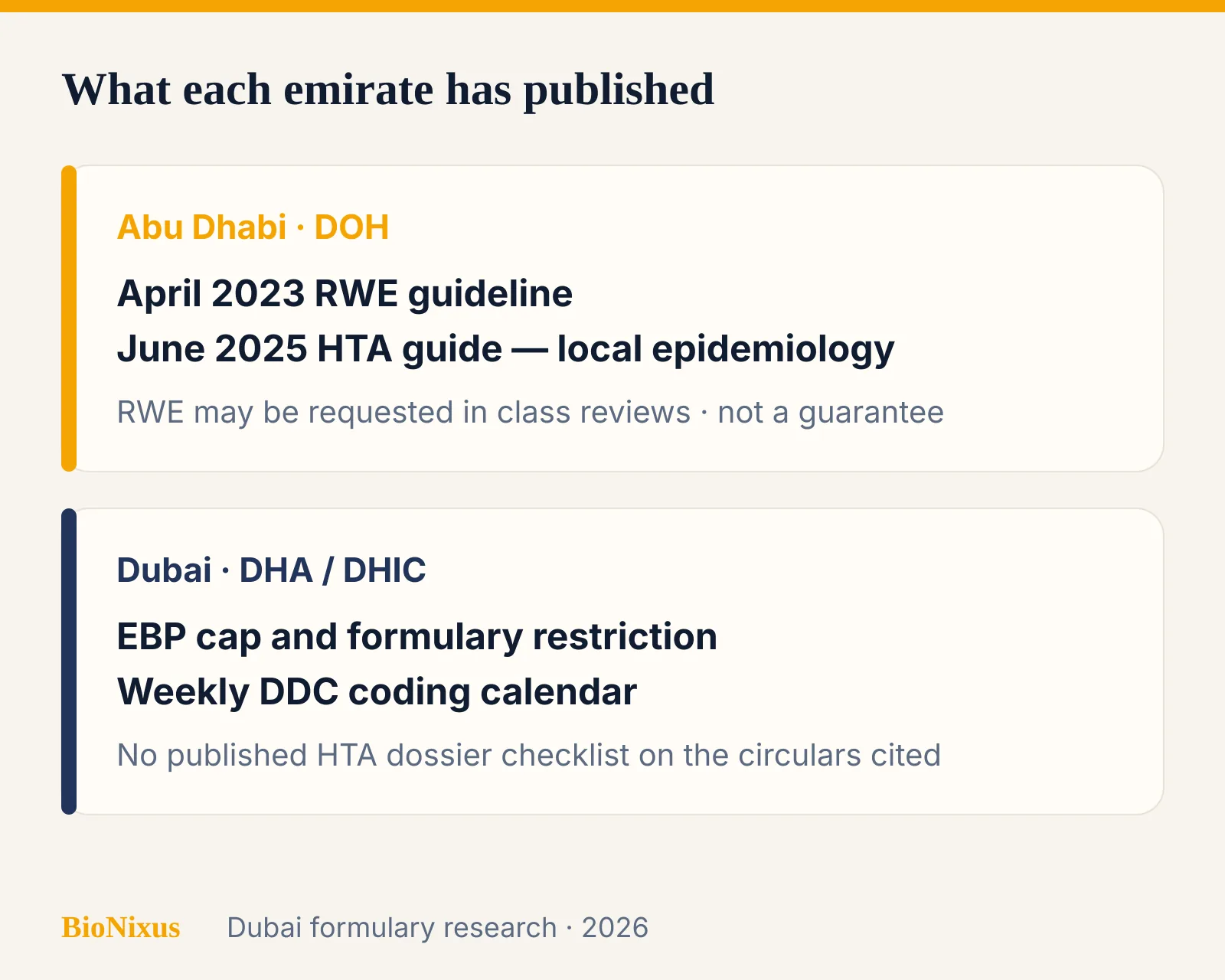
None of that is a DHA circular. It is still the published UAE-payer record on local evidence. A manufacturer affiliate that will later file in Abu Dhabi, or whose enhanced Dubai plans will ask the same questions, should commission the local epidemiology and analog-outcomes file now. A brief that waits until a DOH class review to discover it has only a US RCT has skipped the research. For the Thiqa obesity example of an emirate-specific payer rule, see Thiqa obesity reimbursement in Abu Dhabi.
Dubai’s own published numbers do not fill that gap. The last official national health survey put adult diabetes at 11.8% — a 2017–2018 figure, not a 2026 Dubai treated share (MOHAP National Health Survey; UNDP). FCSC’s 2024 population of about 11.29 million, up 5.7% from 10.68 million in 2023, is a residency count across about 200 nationalities (FCSC). It is not an eligible-patient funnel for a specialty SKU.
What should a Dubai Essential Drug List formulary submission measure?
Design the study backwards from the decision — a DDC assignment, an EBP or enhanced-plan formulary question, or a named hospital Pharmacy and Therapeutics addition.
| Workstream | Decision it answers | What the published record already shows | What to commission |
|---|---|---|---|
| List identity | Which list the forecast is using | DDC is every drug registered with DHA Pharmacy Services; EBP drugs are restricted to formulary products; EDE adopted a 2025 NEML (GC 12/2018; GC 03/2024; EDE Decision 47/2025) | A four-list map for the SKU, not a single “DEDL” cell |
| DDC coding | Whether payers can even code the claim | Pharma companies file to DHA Pharmacy Services; updates release Monday and go live Thursday (eClaimLink DDC registration) | Certificate, invoice and the next Monday slot |
| EBP versus enhanced | Which wallet funds the script | EBP medicines cap is AED 2,500 including coinsurance from 1 January 2025; 30% per prescription; no cover above the cap (GC 03/2024) | Separate PI and enhanced-plan interviews |
| Treated-patient share | Who is already on an analog | National adult diabetes was 11.8% in the last official survey — a prevalence, not a Dubai treated share (MOHAP National Health Survey) | Anonymous PRFs, new versus continuing, by cover type |
| Local RWE | What a UAE payer will accept beside the RCT | DOH’s RWE guideline applies when the outcome will be submitted to DOH for reimbursement decisions; the June 2025 HTA guide may request RWE in class reviews (DOH RWE 2023; DOH HTA 2025) | A local epidemiology and analog-outcomes file, with data-residency rules stated |
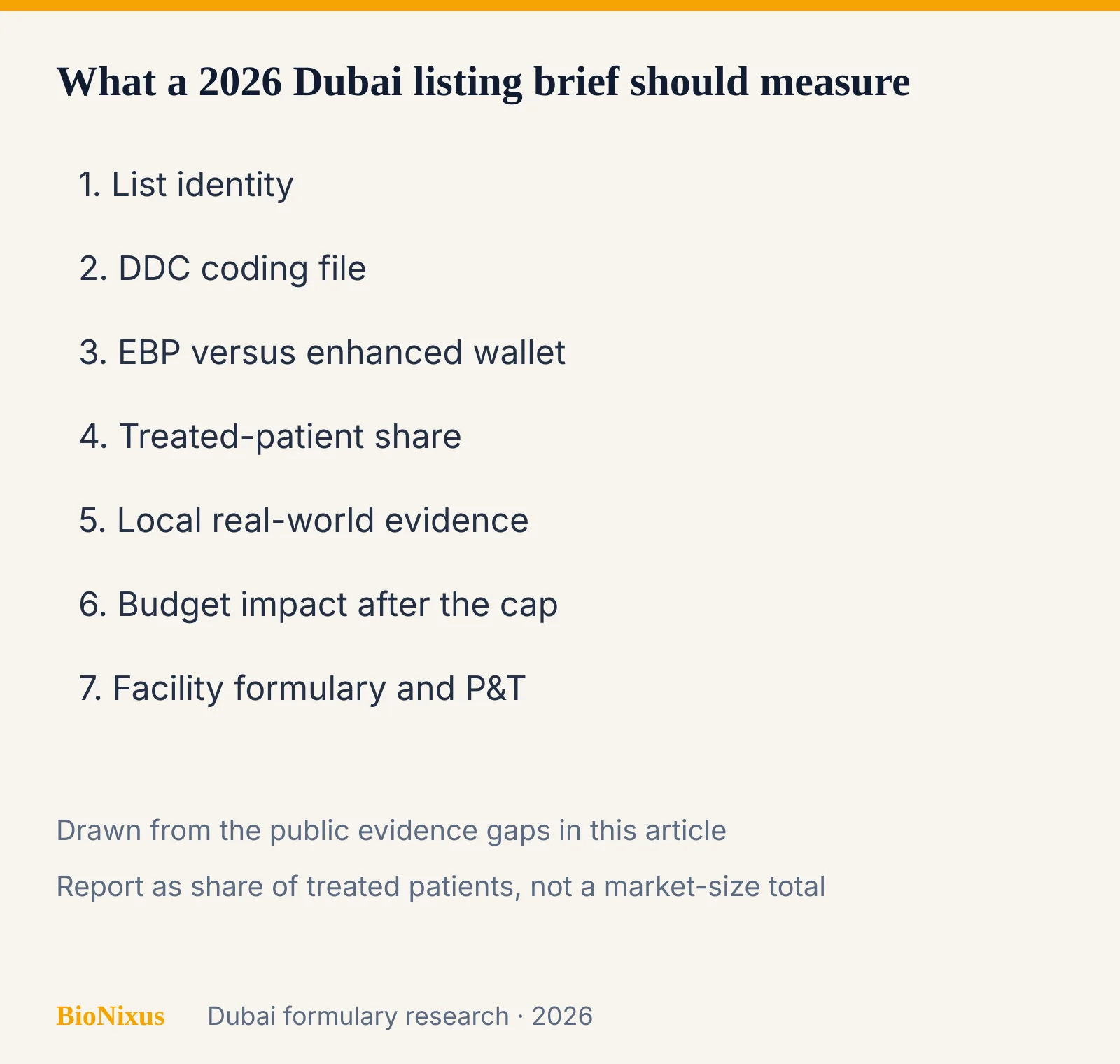
- List identity. Name the DDC extract, EBP restriction, 2025 NEML or facility list the model uses (GC 12/2018; NEML 2025).
- DDC coding file. Certificate, invoice, Monday release, Thursday utilization (eClaimLink; MOHAP).
- EBP versus enhanced wallet. AED 2,500 cap, 30% coinsurance, Participating Insurer versus enhanced director (GC 03/2024).
- Treated-patient share. Anonymous PRFs: new versus continuing, basic versus enhanced, Dubai versus Abu Dhabi.
- Local real-world evidence. Epidemiology and analog outcomes to the published DOH RWE and HTA rules (DOH RWE; DOH HTA).
- Budget impact after the cap. Class spend inside the EBP medicines line and on enhanced plans, not a global invoice only.
- Facility formulary. Which multidisciplinary committee will stock the SKU (DHA Pharmacy Guidelines).
A Dubai EBP answer is not a Thiqa answer and is not a NUPCO award. See healthcare market research in Saudi Arabia and Kuwait.
How should you commission the study?
- How many Dubai payers, TPAs and hospital pharmacists will you recruit, and will you split Participating Insurers from enhanced-plan medical directors?
- Will results be reported by basic versus enhanced cover, by Emirati versus expatriate, and by new versus current cases?
- Which list identity will you use as the base case — DDC, EBP restriction, NEML or a named facility — and why?
- Will the discussion guide treat coding, insurance restriction and facility stock as three layers, not one “DEDL” share?
- Are questionnaires available in Arabic and English?
- Where will identifiable health data sit, given the ICT-in-healthcare residency rule the DOH HTA guide records (DOH HTA)?
- Who owns the data, and can it be re-cut after a circular changes the EBP line again?
Grand View Research, IMARC and IQVIA publish UAE pharmaceutical pages that often appear for this query. Use them to triangulate category spend. Do not take them to a payer meeting as the evidence pack for a Dubai Essential Drug List formulary submission.
A physician-survey design sits on UAE pharmaceutical market research. For the federal price layer after EDE, use the EDE briefing already linked. For the access-process map this page does not repeat, use UAE pricing and reimbursement strategy.
Why BioNixus
BioNixus is a primary market research and market access consultancy for pharmaceutical, medical device and healthcare companies, founded in 2012. It has served 118 clients in 48 countries, has run 127 studies so far in 2026 and works with a network of about 3,200 physicians. Custom study pricing is typically $10k–$60k. Regional leadership offices are in Sheridan, Wyoming (US headquarters), London EC1V 2NX and Cairo (Sheikh Zayed, Giza). Dubai, Al Khobar and Salmiya, Kuwait (Olympia Mall) are field offices, and it is in the process of opening a São Paulo office by the end of 2026. LATAM work is covered from the US office with a strong local consultant network.
Choose BioNixus when the decision depends on why Dubai payers, hospital pharmacists and treating physicians act as they do, rather than on a UAE market-size total. Each study is built around one decision — a DDC file, an EBP or enhanced-plan question, a facility formulary — and is reported as share of treated patients. The delivery commitment is Guaranteed in writing. That guarantee covers the agreed scope and timeline, not the accuracy of findings. Where reviews are relevant, BioNixus has 40 client reviews.
See also healthcare market research in the UAE, pharmaceutical companies in the UAE and top pharmaceutical market research companies in the UAE.
To brief a Dubai Essential Drug List formulary submission study, use the BioNixus contact form or email admin@bionixus.com.
References
- Government of Dubai. Law No. (11) of 2013 Concerning Health Insurance in the Emirate of Dubai. DHA approves packages, prices and co-insurance; cover is mandatory, including free zones such as DIFC. Source (accessed 17 October 2026).
- Dubai.ae. Health Insurance. Law No. 11 of 2013 makes cover mandatory for employers, including free zones, and for sponsors’ dependents; Dubai citizens and government employees are eligible under Enaya. Source (accessed 17 October 2026).
- DHA / ISAHD. GC 12/2018, The Dubai Drug Code (DDC) List and eClaimLink System. Weekly Monday release; Thursday utilization. Each code includes route, form, pack size, price and source. Source (accessed 17 October 2026).
- DHA. eClaimLink DDC Drug Registration. A pharmaceutical company files a MOH certificate (or receipt) and an invoice with cost and selling prices; updates release every Monday. Source (accessed 17 October 2026).
- DHA. eClaimLink home / Data Hub. Publishes current DDC List and DDC SC List update dates. Source (accessed 17 October 2026).
- DHA / ISAHD. GC 03/2024 (23 July 2024). From 1 January 2025 the EBP medicines cap is AED 2,500 including coinsurance; 30% per prescription; restricted to formulary products where available. Source (accessed 17 October 2026).
- DHA / ISAHD. PD 01/2021 (21 November 2021). Previous EBP medicines cap AED 1,500 including coinsurance; same 30% coinsurance and formulary restriction. Source (accessed 17 October 2026).
- DHA / ISAHD. GC 06/2024. Twenty Participating Insurers permitted to sell the EBP to the low-salary band from 1 January 2025 to 31 December 2025. Source (accessed 17 October 2026).
- ISAHD. DHA Participating Insurers Results. The EBP is the DHA minimum; only Participating Insurers may sell it to residents earning AED 4,000 or less per month. Source (accessed 17 October 2026).
- ISAHD. Employer Information Pack v5.0 (1 July 2015). Confirms the EBP floor and the AED 4,000 salary band. Source (accessed 17 October 2026).
- DHIC / ISAHD. GC 05-2025 (7 October 2025). New Policy Directives revoke and replace named earlier ISAHD circulars. Source (accessed 17 October 2026).
- DHA Health Regulation Sector. Pharmacy Guidelines, Version 1 (2021). A facility formulary may be created by a multidisciplinary committee and reviewed at least once within 24 months. Source (accessed 17 October 2026).
- Emirates Drug Establishment. Legislations page. Lists Decree-Law 28/2023 and Chairman Decision 47/2025 adopting the NEML on 19 June 2025. Source (accessed 17 October 2026).
- EDE. Attachment to Chairman Decision No. (47) of 2025. 2025 National Essential Medicines List by therapeutic class. Source (accessed 17 October 2026).
- DHA-hosted copy of EDE Chairman Decision No. (47) of 2025, dated 19 June 2025, with the 2025 UAE NEML attached. Source (accessed 17 October 2026).
- World Health Organization. United Arab Emirates: National Essential Medicine List 2025 (English). Posted 3 June 2026. Source (accessed 17 October 2026).
- MoHAP. Transfer of 44 core services to EDE, 5 January 2026, including individual-product re-pricing and regulated-medicine price lists. Source (accessed 17 October 2026).
- UAE Legislation. Federal Decree-Law No. 28 of 2023 establishing the UAE Drug Corporation. Effective 30 September 2023. Source (accessed 17 October 2026).
- UAE Legislation. Federal Decree-Law No. 38 of 2024. Issued 1 October 2024; effective 2 January 2025. Source (accessed 17 October 2026).
- FAOLEX English text. Federal Decree-Law No. (38) of 2024. Article 20: marketing a medical product requires a specific Board-set price. Source (accessed 17 October 2026).
- DOH Abu Dhabi. RWE guideline, April 2023 (DOH/GL/RWD_RWE/V1). Applies when the outcome will be submitted to DOH for regulatory, clinical or reimbursement decisions. Compliance does not guarantee a favourable decision. Source (accessed 17 October 2026).
- DOH Abu Dhabi. HTA Guidelines, June 2025. Local epidemiology is mandatory; RWE may be requested in class reviews. Out of scope includes utilization under AED 10 million a year. Notes Federal Law No. (2) of 2019 on ICT in healthcare. Source (accessed 17 October 2026).
- DOH Abu Dhabi. Managed Entry / Risk Sharing policy. DOH may request more data; the company has no access to patient-confidential data. Source (accessed 17 October 2026).
- FCSC. Unified UAE Numbers (English), December 2025. Population about 11.29 million in 2024, up 5.7% from 10.68 million in 2023; about 200 nationalities. Source (accessed 17 October 2026).
- MoHAP. National Health Survey. Adult diabetes 11.8% (2017–2018 STEPS-style figure), down from 18.9% in 2010. Not a 2026 treated share. Source (accessed 17 October 2026).
- UNDP / Gulf Health Council. UAE NCD investment case. Notes the 11.8% diabetes figure and Dubai’s Saada and Abu Dhabi’s Thiqa programmes. Source (accessed 17 October 2026).
- WAM. EDE H1 2026, 22 September 2026. To 30 June 2026: 942 product approvals; 20 pricing decisions; 2,030 inspection visits. Source (accessed 17 October 2026).
- EDE. Re-Pricing of a Single Medical Product. Country-of-origin certificate plus Gulf and European references; fees AED 1,000 plus AED 500. Source (accessed 17 October 2026).
- Grand View Research. United Arab Emirates pharmaceutical market outlook pages. Syndicated category sizing, not a primary-research file on a Dubai Essential Drug List formulary submission. (accessed 17 October 2026).
- IMARC Group. UAE pharmaceutical market report pages. Syndicated market-size commentary that often occupies “UAE pharmaceutical market” queries. (accessed 17 October 2026).
- IQVIA. UAE and Middle East pharmaceutical audit and market commentary. Useful for national audit context; it does not replace a Dubai Drug Code, Essential Benefits Plan or payer-listing primary-research file. (accessed 17 October 2026).