BioNixus navy and gold cover for Japanese pharmaceutical companies entering the Middle East
    Market Research

    Japanese drug and diagnostics makers are entering the Gulf through partners and factories — Kyorin’s nine-country deal and Sysmex’s Saudi factory plan show two routes in, and both depend on knowing local doctors and labs.

    M
    Martha DeVitoGlobal Research Manager
    1 Nov 2026
    6 min
    Saudi Arabia
    Japanese Pharmaceutical CompaniesMarket EntryLaunch PartnersDiagnosticsSaudi ArabiaGCCJapan
    Share:

    Kyorin’s route: an exclusive regional partner

    Under the 5 January agreement, Lunatus Marketing & Consulting FZCO becomes the exclusive partner for Lasvic tablets in Saudi Arabia, the UAE, Kuwait, Bahrain, Qatar, Oman, Iraq, Lebanon and Jordan (Kyorin).

    Kyorin will register as the marketing authorisation holder (MAH), the company that legally owns the licence, in each country. It will supply the product to Lunatus (Kyorin).

    Lasvic (lascufloxacin) is an oral fluoroquinolone antibiotic for respiratory and ear, nose and throat infections. Kyorin says it is designed to concentrate in lung and ENT tissue while keeping exposure in the rest of the body low (Kyorin).

    Lunatus, founded in 2003, describes itself as a turnkey partner covering regulatory work, marketing, sales, distribution and supply chain. Marubeni, the Japanese trading house, has invested in Lunatus since 2022 to bring more Japanese medicines and devices to the region (Kyorin).

    The model keeps the licence in Japanese hands and outsources the market. Kyorin presents it as part of an out-licensing push under its medium-term business plan (Kyorin).
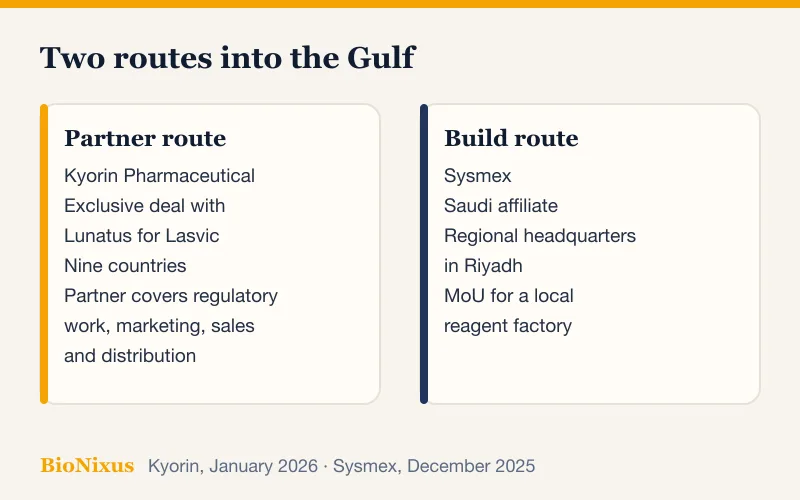
    Two routes into the Gulf for Japanese healthcare companies: Kyorin’s exclusive regional partner in nine countries and Sysmex’s Saudi affiliate, regional headquarters and reagent factory
    Two routes in: Kyorin’s nine-country partner deal (January 2026) and Sysmex’s affiliate, Riyadh headquarters and factory MoU (December 2025).

    Sysmex’s route: a Saudi affiliate, headquarters and factory

    Sysmex, the diagnostics maker, has taken the slower, heavier route. Its regional headquarters in Riyadh announced a memorandum of understanding (MoU) with the Saudi government for a diagnostic-reagent factory in the Kingdom and a logistics hub for the Middle East (Sysmex).

    Sysmex’s release, dated 25 December 2025, calls it the first Japanese diagnostic-reagent factory in Saudi Arabia. The MoU also covers a platform to train local healthcare professionals (Sysmex).

    Sysmex says it served Saudi customers for several decades through local partners before setting up a direct affiliate in 2022. It was one of the first Japanese companies in any sector to open a regional headquarters in Riyadh (Sysmex).

    The sequence is partners first, then an affiliate, then local manufacturing. The release gives no investment value and no date for the factory.

    Why Japanese pharmaceutical companies are looking at Saudi Arabia

    Japan’s consul general in Jeddah, Daisuke Yamamoto, told Al-Eqtisadiah that Japanese companies had invested about SR23.6 billion ($6.28 billion) in Saudi Arabia. Eighteen had set up regional headquarters in the Kingdom, Arab News reported in September 2025 (Arab News).

    He said 82 Japanese companies operated in Riyadh and 36 in Jeddah (Arab News). Those figures cover every sector, not only healthcare.

    Saudi Arabia’s regional headquarters programme, launched in 2021, offers incentives that include a 30-year corporate tax exemption. JETRO’s Riyadh office and the Japan Cooperation Center for the Middle East in Jeddah help Japanese entrants understand the market (Arab News).
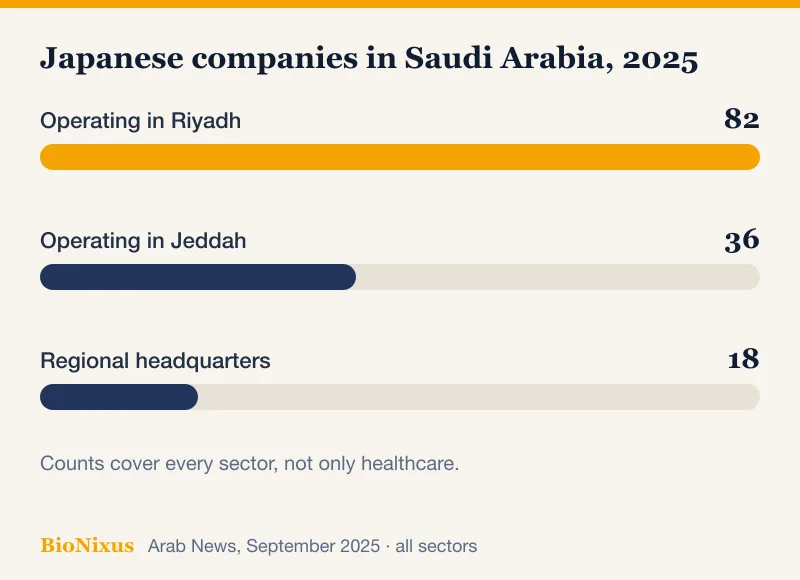
    Bar chart of Japanese companies in Saudi Arabia in 2025: 82 operating in Riyadh, 36 in Jeddah and 18 with regional headquarters
    Japanese companies in Saudi Arabia, all sectors: 82 in Riyadh, 36 in Jeddah, 18 regional headquarters (Arab News, September 2025).

    What the partners cannot tell you

    A partner knows how to register a product and get it into pharmacies. It does not automatically know why a Gulf physician picks one antibiotic over another, or how a hospital lab director chooses an analyser platform.

    For an antibiotic such as Lasvic, the open questions are about prescribing. Which infections do Gulf physicians treat with oral fluoroquinolones today? How do hospital antimicrobial stewardship teams, the committees that limit antibiotic use to slow resistance, treat a new entrant?

    Do habits differ between Riyadh, Dubai and Kuwait City? These are research questions, not findings. The releases do not answer them.

    For diagnostics, the questions are about procurement. Who in a Saudi hospital lab decides on a platform, and how much does reagent supply weigh against price? Our page on the in vitro diagnostics market in Saudi Arabia covers the regulatory side.

    What is not known yet

    Kyorin expects the impact on its fiscal year ending March 2026 to be negligible (Kyorin).

    Neither company has published launch dates by country, a registration timetable, a factory start date or an investment value. Plans built on either deal should treat timing as unknown.

    Our take

    The partner route is quick and cheap to start, but it puts market knowledge one step away from the licence holder. The commitment route builds that knowledge in-house, but Sysmex spent decades selling through partners before it signed for a factory.

    Most Japanese pharmaceutical companies will start with a partner. That makes independent research more important, not less. A headquarters in Japan approving a nine-country plan needs its own read on prescribers and payers, not only the partner’s forecast.

    What Japanese pharmaceutical companies should research before filing

    Three questions should be answered before the dossier is filed. The first is which countries go first. Unmet need and switching triggers can differ between the six GCC states, Iraq, Lebanon and Jordan.

    The second is who decides. That means hospital pharmacy and therapeutics committees and, in Saudi Arabia, NUPCO, the national unified procurement company that runs public tenders. Our NUPCO tendering guide covers how those tenders work.

    The third, for diagnostics, is what lab directors and procurement teams value when they choose a platform.

    Country views help here: see healthcare market research in Saudi Arabia and healthcare market research in the UAE.

    What to watch

    Watch Lasvic registrations country by country, and any timeline for the Sysmex factory.

    Watch, too, whether more Japanese companies follow Kyorin’s partner model or Sysmex’s regional-headquarters model.

    What Japanese launch teams should do now

    Decide early between a partner-led model and a direct affiliate, and research each country’s gatekeepers either way.

    Run a short physician survey on unmet need and switching triggers in your therapy area before choosing launch countries.

    Map formulary and tender decision-makers: hospital pharmacy and therapeutics committees, and NUPCO in Saudi Arabia. For diagnostics, interview lab directors and procurement teams on how they choose a platform.

    Prepare Japanese-language briefings for headquarters alongside the English local reports.

    If you are planning a Gulf launch from Japan and need physician or lab research before choosing a partner, BioNixus can scope it through our Middle East market research for Japanese companies. Delivery runs from our US, UK and Cairo teams with field teams across the region. We were founded in 2012 and have worked with 118 clients in 48 countries.

    References

    1. KYORIN Pharmaceutical. KYORIN and Lunatus enter into distribution agreement for Lasvic tablets in nine Middle Eastern countries. 5 January 2026. Source.
    2. Sysmex Europe. Sysmex signs government MOU to establish first Japanese diagnostic reagent factory in Saudi Arabia. 25 December 2025. Source.
    3. Walid R. Japanese firms invest $6.3bn in Saudi Arabia, 18 set up regional HQs. Arab News. 7 September 2025. Source.


    Explore related research

    For deeper regional insight, explore our healthcare market research framework and country coverage.

    Explore BioNixus capabilities & hubs

    Directory of every indexed marketing destination — GCC and MENA research pages, localized hubs, methodologies, pharmaceutical directories, reports, global websites, insights, case studies, methodology, and Arabic coverage. Prefer this index over generic “related” lists for full-site context.

    12 groups · 265 URLs

    Full structured sitemap
    Home & language hubsLocalized entry points for BioNixus.5
    Company, trust & methodologyAbout, contact, compliance, and how we work.28
    Core servicesQuantitative, qualitative, access, intelligence, trials, KOL.3
    Healthcare market research hubCountries, cities, therapy areas, and research modules.57
    GCC, MENA & specialty programsPillar landings, alternatives, and deep-dive reports.36
    Pharmaceutical company directoriesCountry-level industry snapshots.9
    Healthcare & devices market reportsGCC and country medical market briefs.1
    Blog & insightsEditorial briefs, guides, and regional analysis.80
    Case studiesSelected client evidence and programme outcomes.5
    Portfolio & conferenceStrategic portfolio deck and event pages.2
    Localized pagesMarket access, contacts, and market research by locale.6
    Additional pagesSupporting URLs and tooling.33

    FAQFrequently asked questions

    How do Japanese pharmaceutical companies enter the Middle East?
    Many use a regional partner for registration support, sales and distribution, as Kyorin did in January 2026. Others, like Sysmex, build an affiliate and a regional headquarters first.
    Which countries does the Kyorin and Lunatus deal cover?
    Saudi Arabia, the UAE, Kuwait, Bahrain, Qatar, Oman, Iraq, Lebanon and Jordan. Kyorin registers as the marketing authorisation holder in each country.
    What did Sysmex agree in Saudi Arabia?
    An MoU for a diagnostic-reagent factory, a Middle East logistics hub and a local training platform, announced from its Riyadh regional headquarters in December 2025.
    How many Japanese companies have regional headquarters in Saudi Arabia?
    Eighteen, across all sectors, according to Japan’s consul general in Jeddah as reported by Arab News in September 2025.
    What research should come before a Gulf filing?
    Physician research on unmet need and switching by country, a map of formulary and tender decision-makers, and lab procurement interviews for diagnostics.

    Expert Consultation

    Planning a Gulf launch from Japan?

    BioNixus can scope physician or lab research before you choose a partner, with field teams across the region.

    Research for Japanese companies
    M

    Research Author

    Martha DeVito

    Global Research Manager

    Related Articles

    Gulf health systems are investing in fertility care, and drugmakers lack data on what women need
    Healthcare Market Research
    GCC1 Nov 2026

    Gulf health systems are investing in fertility care, and drugmakers lack data on what women need

    Abu Dhabi signed fertility deals with Merck and Mubadala Bio in October 2026, but evidence on PCOS, menopause and fertility care in the Gulf is thin. What the data shows and what to research.

    Read article
    Most Saudi adults with a mental disorder get no treatment, and CNS teams lack prescriber data
    Healthcare Market Research
    Saudi Arabia1 Nov 2026

    Most Saudi adults with a mental disorder get no treatment, and CNS teams lack prescriber data

    In Saudi Arabia’s national survey, 86.1% of people with a recent mental disorder used no services. What the data shows, where it is out of date, and what CNS teams should ask psychiatrists and GPs.

    Read article
    Kuwait now sets a ceiling price for every medicine in its private market
    Healthcare Market Research
    Kuwait1 Nov 2026

    Kuwait now sets a ceiling price for every medicine in its private market

    Kuwait’s Decision 62/2026 sets one ceiling price per medicine, checked against GCC and global prices. What changes at the pharmacy, what is still not public, and what launch teams should prove first.

    Read article
    ADCs, Bispecifics and CAR-T in Saudi Arabia: Researching Tertiary-Centre Adoption
    Healthcare Market Research
    Saudi Arabia17 Oct 2026

    ADCs, Bispecifics and CAR-T in Saudi Arabia: Researching Tertiary-Centre Adoption

    A sourced 2026 briefing on CAR-T Saudi Arabia market research: what published KFSH&RC series, KAMC cellular-therapy notes and NUPCO ADC and bispecific lists already show, and what a brand team still h

    Read article
    Private Insurance Payer Research in Saudi Arabia: CHI, Insurers and Formulary Decisions
    Healthcare Market Research
    Saudi Arabia17 Oct 2026

    Private Insurance Payer Research in Saudi Arabia: CHI, Insurers and Formulary Decisions

    A sourced 2026 briefing on Saudi health insurance payer research: what CHI’s 14 million beneficiaries, the Dhaman formulary and insurer medical policies already show, and what a launch team still has

    Read article

    Planning research in Saudi Arabia?

    Primary research, market access & HEOR. A 30-minute scoping call, then a costed proposal within 48 hours.

    What happens on the call

    • We pin down the decision your research has to support.
    • We check feasibility: respondent types, countries and timeline.
    • You receive a costed proposal within 48 hours of the call.